
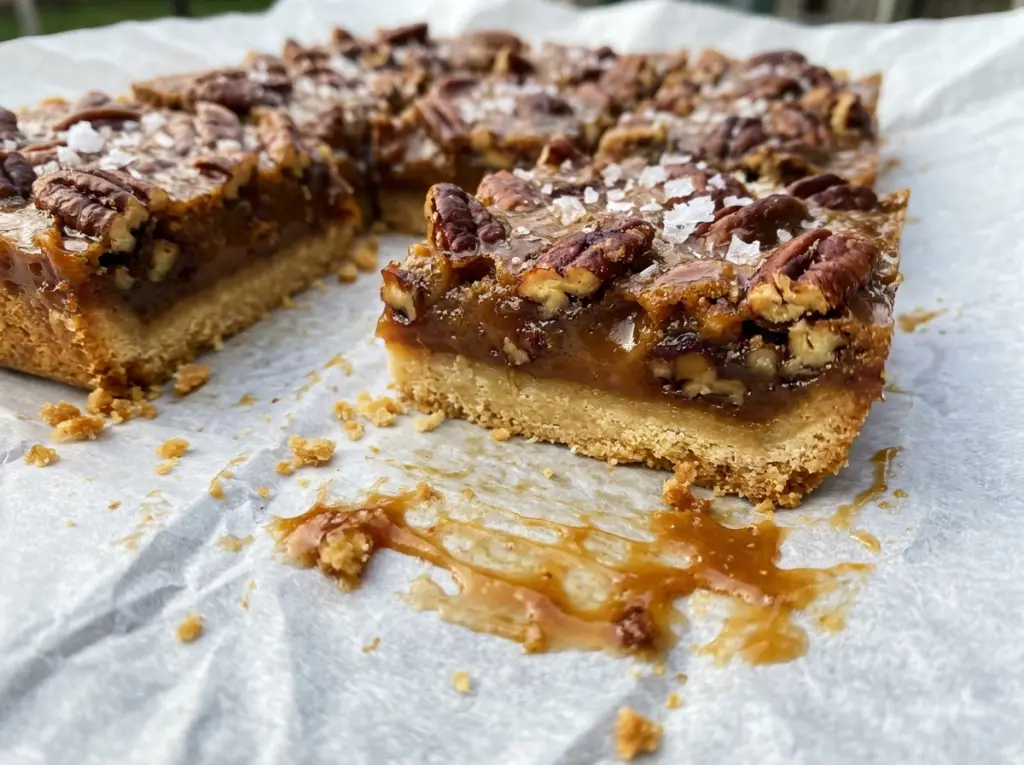
The topping gives you the first clue that these bars are different from a standard pecan pie: it bubbles across the whole pan, and the edges turn a deep golden brown before the center has a chance to look firm. That’s exactly what I want to see. The caramel is still soft when the pan comes out, and the shortbread underneath gives each piece a sturdy, buttery base.
I make these salted caramel pecan pie bars with a shortbread crust whenever I want the familiar pecan-pie combination without rolling out pastry or slicing a whole pie. The crust gets a head start in the oven, then the stovetop caramel and pecans go over it while it’s hot. That gives you distinct layers: crisp-tender shortbread, a chewy caramel middle, and pecans with just enough flaky salt to balance the sweetness.
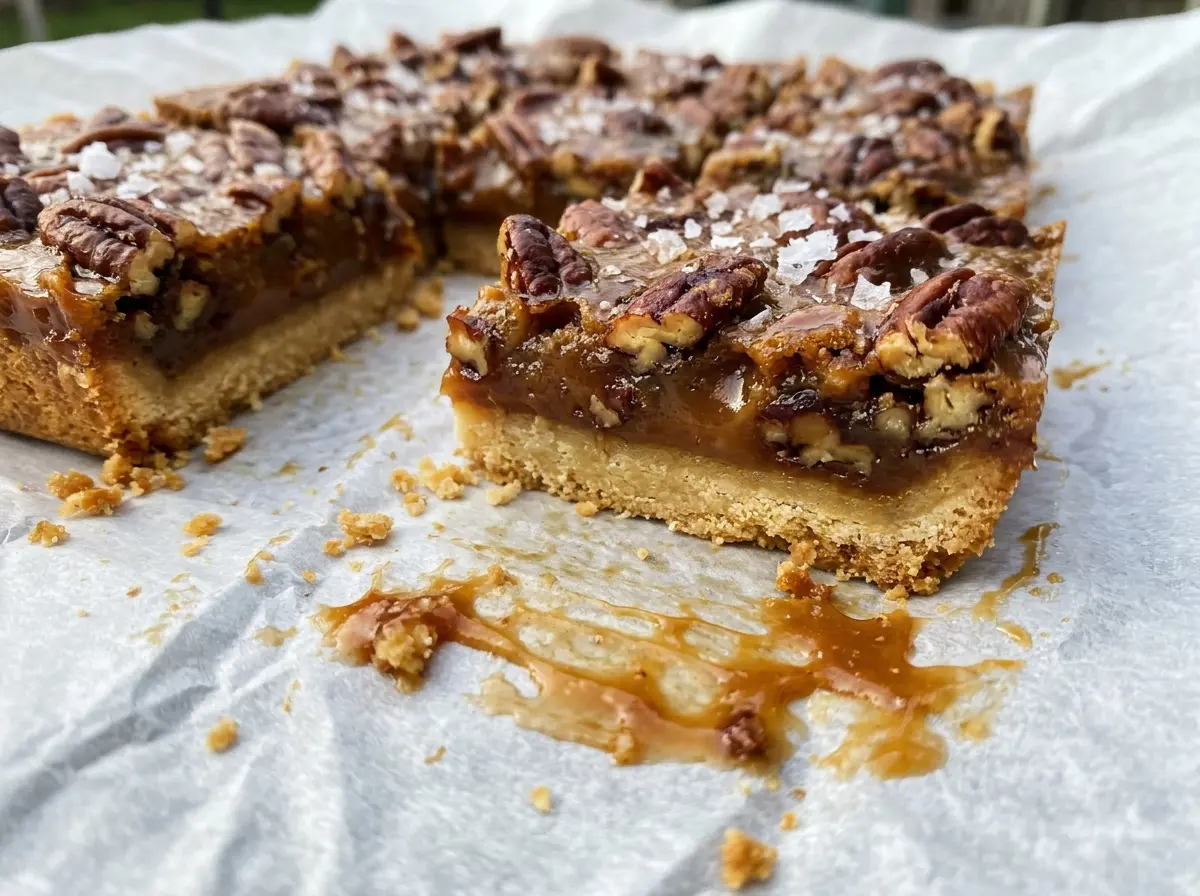
Kitchen Note
Give the bars the full cooling time in the pan before you lift them out. The caramel needs about 3 hours to settle, and cutting too soon makes the layers slide instead of giving you neat squares.
Save these salted caramel pecan pie bars for a bake that brings together buttery shortbread, chewy caramel, and a flaky-salt finish.
Why These Pecan Bars Set Without an Egg Custard
Classic pecan pie usually depends on an egg-based filling. These bars take a different route: brown sugar, honey, butter, and heavy cream become a stovetop caramel, then bake with the pecans over the shortbread. There’s no custard to judge by a wobbling center, and no pastry shell to roll or crimp. Instead, watch for the topping to bubble across the surface and the edges to turn deep golden.
That two-part cooking is useful because the syrup is already combined before it reaches the oven. Bringing the butter, sugar, honey, and cream to a full boil first gives the topping a head start; the final bake brings everything together with the nuts. The caramel will still look soft when it’s hot, which can make it seem underdone. It firms as it cools, so don’t wait for it to look stiff in the pan. The hot crust underneath also gives the topping a warm, even surface to spread across.
What Gives the Shortbread Its Snap and the Pecan Layer Its Chew
- All-purpose flour — It gives the crust enough structure to hold the sticky topping without turning into a crumbly base. A standard, reasonably fresh bag works well here; there’s no need for specialty flour. If you need a gluten-free version, use a cup-for-cup gluten-free baking blend in the crust; the shortbread may be a little more delicate.
- Unsalted butter — Butter supplies the rich, tender texture in the crust and helps build the caramel. Regular grocery-store butter is fine, but use unsalted so the fine salt and flaky finish stay in balance. Salted butter will make the bars taste saltier.
- Brown sugar, honey, and heavy cream — Brown sugar brings molasses depth, honey helps make a cohesive syrup, and heavy cream rounds out the caramel. Light brown sugar keeps the flavor balanced; dark brown sugar gives a deeper molasses note. If you don’t have honey, light corn syrup can stand in volume-for-volume, though you’ll lose honey’s floral edge. Use heavy cream rather than a thinner milk, which won’t give the topping the same richness.
- Pecans — Fresh pecans should smell sweet and nutty, not stale or oily; that flavor carries through the whole topping. Coarse pieces give the bars their characteristic crunch. Coarsely chopped walnuts can replace the pecans volume-for-volume for a slightly earthier, less buttery taste.
- Flaky sea salt and vanilla — Flaky salt gives the finished surface a light crunch and distinct salty pops, while vanilla rounds out the caramel. Pure vanilla extract is a good choice, but the store-brand bottle works just fine. Keep the flaky salt for the top; fine table salt won’t give the same texture.
The Four Stages That Keep the Crust Firm and the Caramel Even
Press and prebake the shortbread
Heat the oven to 350°F and line a 9×13-inch pan with parchment, leaving overhang on two sides. Whisk the flour, granulated sugar, and fine salt, then stir in the melted crust butter until no dry patches remain. Press the mixture into an even layer; thin spots can bake up fragile, while thicker patches stay soft. Bake for 20–25 minutes, until the edges are lightly golden and the surface looks set.
Bring the caramel to a full boil
In a 3-quart saucepan, combine the remaining butter with the brown sugar, honey, and heavy cream over medium heat. Stir as the butter melts, and keep going until the mixture reaches a full boil rather than just showing a few small bubbles at the edge. Boil for 1 minute, then take the pan off the heat. Stir in the vanilla and pecans; the mixture will be thick and glossy.
Spread the topping over the hot crust
Pour the pecan mixture over the crust while the crust is still hot, then spread it evenly across the surface. Work it toward the edges so the pecans aren’t piled in the middle. Return the pan to the oven and bake for 20–25 minutes. Look for bubbles across the topping and deep golden edges; if the center hasn’t begun bubbling, it needs more time in the oven.
Salt, cool, and cut
Sprinkle the flaky sea salt over the topping as soon as the pan comes out of the oven. The hot surface helps the flakes settle in place without losing all their texture. Set the pan aside and let the bars cool completely, about 3 hours. Use the parchment overhang to lift them out, then cut into 24 bars.
Two Useful Ways to Adapt These Pecan Bars
Make the crust gluten-free
Use a cup-for-cup gluten-free baking blend in place of the all-purpose flour. The crust can be more fragile than the wheat version, so press it into a level, compact layer before baking and let the bars cool fully before lifting them from the pan.
Use dark brown sugar for deeper caramel
Swap dark brown sugar for the light brown sugar in the topping. Its stronger molasses flavor makes the caramel taste darker and less delicate, while the bars keep the same chewy texture.
Storage and Reheating
- Refrigerator: Store the cooled bars in an airtight container for up to 5 days. The shortbread firms up when chilled, so the texture is less tender straight from the fridge.
- Freezer: Freeze individual bars in an airtight container, with parchment between layers, for up to 2 months. Thaw them in the refrigerator before serving.
- Reheating: These bars don’t need reheating. Let chilled bars sit at room temperature for about 20 minutes; microwaving can make the caramel overly hot and sticky.
Questions That Come Up When Making Pecan Pie Bars
Salted Caramel Pecan Pie Bars With Shortbread Crust Recipe
Ingredients
Equipment
Method
- Heat the oven to 350°F.
- Line a 9x13-inch baking pan with parchment paper, leaving overhang on two sides.
- Whisk the flour, granulated sugar, and fine salt in a large bowl.
- Melt 1 cup of the butter.
- Stir the melted butter into the flour mixture until no dry patches remain.
- Press the mixture evenly into the prepared pan.
- Bake for 20–25 minutes, until the edges are lightly golden and the surface looks set.
- Combine the remaining 1 cup butter, brown sugar, honey, and heavy cream in a 3-quart saucepan over medium heat, stirring until the butter melts and the mixture comes to a full boil.
- Boil for 1 minute.
- Remove the pan from the heat.
- Stir in the vanilla and pecans.
- Pour the topping over the hot crust.
- Spread the topping evenly.
- Bake for 20–25 minutes, until the topping bubbles across the surface and the edges are deep golden.
- Sprinkle the flaky sea salt over the hot topping.
- Cool completely in the pan, about 3 hours.
- Lift the bars out and cut into 24 bars.