
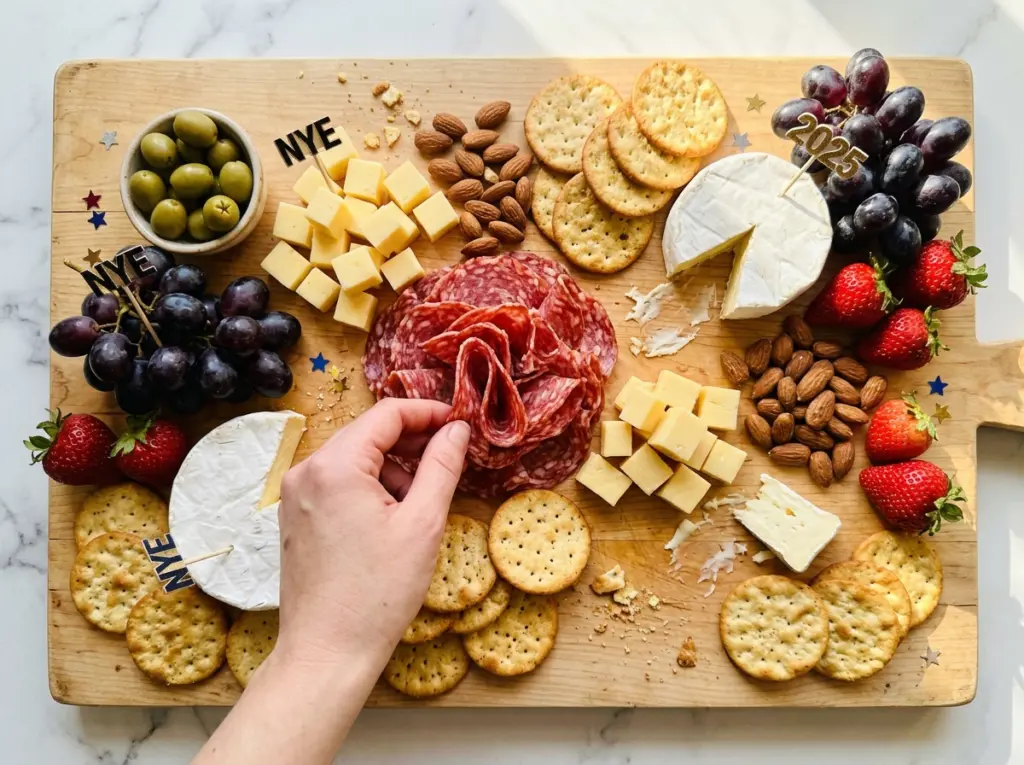
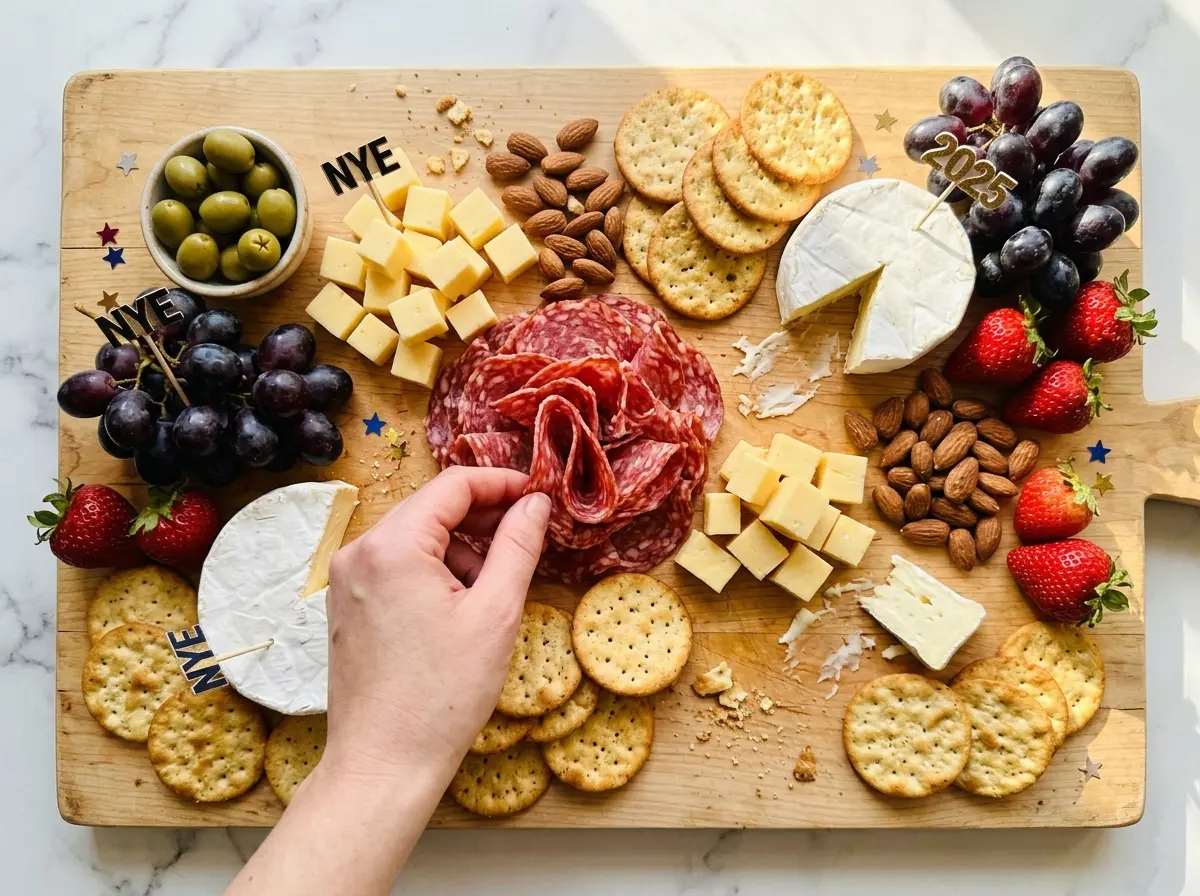
On an 18-by-12-inch board, the cheeses need a little breathing room or the crackers and fruit start looking like one crowded pile. I set up this New Year’s Eve Charcuterie Board with that in mind: a few clear spaces make it easier to see what’s there and reach for a bite without shifting the whole spread.
The mix works because every bite can go in a different direction. Sharp cheddar and cured meat bring savory, salty notes; Brie, fig jam, and honey soften them, while fruit and dark chocolate add their own sweet contrast. I keep the fruit in small clusters rather than scattering it, so the board looks inviting and the colors stay distinct. It’s a generous spread for eight, with enough variety to make lingering over a snack feel like the point.
Kitchen Note
Slice the apple just before serving, not while you’re setting up the rest of the board. Once cut, it starts to brown, and those fresh slices look best when they go straight onto the spread.
Save this New Year’s Eve Charcuterie Board for a festive spread with salty cured meats, creamy Brie, crisp fruit, and chocolate to finish.
Why This Board Needs Breathing Room Between the Cheeses
An 18-by-12-inch board gives the ingredients room to read as separate choices instead of one packed assortment. That matters with eight ounces each of cheddar, Brie, and cured meats alongside two kinds of crackers, fruit, olives, almonds, jam, honey, and chocolate. The cheeses take up space, but they also give the eye a place to land among all those smaller pieces.
Leaving open space between the cheeses does more than make the board look tidy. It creates little landing spots for crackers and fruit, and makes it easier to build a bite without reaching across another ingredient. Small clusters help, too: grapes and blackberries stay recognizable as fruit, while olives and almonds remain easy to pick out as savory bites. If everything is arranged edge to edge, those distinctions disappear and the board feels harder to navigate.
This is a grazing board, not a precise pattern. Keep the ingredients visible, leave a few gaps, and let the natural variety do the decorating. That loose structure is what makes the spread feel abundant without looking jumbled.
What the Two Cracker Boxes Add to This New Year’s Eve Board

- Cured meats — An assortment gives you a change in texture and shape across the board. Salami holds its shape when folded, while prosciutto makes soft, loose folds; either is a sensible choice if you’re buying just one kind.
- Sharp cheddar and Brie — The cheddar brings a firm, savory bite, while Brie is soft and creamy beside it. Keep both distinct rather than treating one as a stand-in for the other. Cut the cheddar into cubes or thin slices and the Brie into wedges so each is easy to pick up.
- Assorted crackers and water crackers — The assorted box brings variety, and water crackers give you a plainer, crisp base for stronger bites. If you can’t find water crackers, use crackers from the assorted box instead; you’ll have less contrast, but the board still works.
- Grapes, blackberries, and apple — These fresh fruits bring juiciness and a crisp, tart note that balances the richer cheeses. Wash and dry the grapes and blackberries well so excess water doesn’t collect on the board. The apple is best thinly sliced.
- Dried apricots and olives — Dried apricots add a chewy fruit option, while pitted mixed olives bring a briny, savory contrast. Draining the olives matters: extra brine can run into nearby crackers.
- Roasted almonds — These add a firm, crunchy bite among the softer fruit and cheese. Use roasted almonds you enjoy eating on their own; there’s no need to seek out a specialty variety.
- Fig jam and honey — The two bowls give the cheese different sweet pairings: fig jam is thick and fruit-forward, while honey is easy to drizzle. Put them in separate small bowls so each stays distinct.
- Dark chocolate — Broken pieces are easy to tuck into the remaining spaces and offer a bittersweet finish. A bar that breaks cleanly into bite-size pieces is convenient; no extra preparation is needed beyond breaking it up.
The Assembly Order That Keeps This Board Easy to Graze
Set Out the Board and Bowls First
Use an 18-by-12-inch serving board and set out two small bowls before arranging the food. Spoon the fig jam into one bowl and the honey into the other. Doing this first gives you a clear sense of how much board space the bowls take up. It also means you won’t have to squeeze them into a crowded spot at the end.
Give the Meats and Cheeses Their Places
Arrange the cured meats, cheddar, and Brie on the board before filling in the smaller ingredients. Fold or fan the meats so they’re easy to lift rather than stuck in a flat stack. Leave spaces between the cheeses; those open areas help the main pieces stay distinct. Cut cheddar into cubes or thin slices, and keep Brie in wedges.
Build the Fruit and Savory Clusters
Add the crackers, grapes, apple slices, blackberries, dried apricots, olives, and almonds in small clusters around the meats and cheeses. Thinly slice the apple just before serving, as it browns after cutting. Keep the olives drained so brine doesn’t spread across the board. Small groups make it easier to see each choice and reach for it.
Fill the Remaining Spaces and Serve
Set the bowls of fig jam and honey on the board, then tuck the broken dark chocolate into the remaining spaces. Don’t force every ingredient into a perfectly even pattern; the small gaps are part of what keeps the board approachable. Once everything is arranged, serve the board.
Three Ways to Rework This New Year’s Eve Charcuterie Board
A vegetarian board with the same sweet-and-savory balance
Leave out the cured meats and use additional cheddar and Brie in their place. The board will have more cheese and fewer salty, meaty bites, while the fruit, olives, crackers, and sweet accompaniments still give guests plenty of variety.
A salami- or prosciutto-led spread
Use salami for a firmer, easy-to-fold meat selection, or choose prosciutto for soft, delicate folds. Either choice stays within the cured-meat options for this board; the texture of each bite changes, but the cheese and sweet pairings still fit.
A sweet-and-savory split
Arrange the cured meats, cheeses, olives, and almonds together, then group the fruit, jam, honey, and chocolate in another area. It changes the way people graze without changing the ingredients, and makes it easy to choose a savory bite or a sweeter one.
Make-Ahead and Serving
- Prep ahead: Wash and dry the grapes and blackberries, drain the olives, and portion the jam and honey into their bowls. Keep prepared perishable ingredients covered in the refrigerator; slice the apple just before serving.
- Leftovers: Refrigerate leftover cured meats, cheeses, fruit, and olives in covered containers, with crackers stored separately. Use refrigerated leftovers within 3 to 4 days.
- Freezer: I don’t freeze an assembled board. The fruit softens after thawing, and the crackers lose their crisp texture.
- Serving: Don’t leave perishable meats, cheeses, and cut fruit out for more than 2 hours, or more than 1 hour when the temperature is above 90°F.
Questions That Come Up While Building This Board
New Year's Eve Charcuterie Board
Ingredients
Equipment
Method
- Set out an 18x12-inch serving board and two small bowls; spoon the fig jam into one bowl and the honey into the other.
- Arrange the cured meats, cheddar, and Brie on the board, folding or fanning the meats and leaving spaces between the cheeses.
- Add the crackers, grapes, apple slices, blackberries, dried apricots, olives, and almonds in small clusters around the meats and cheeses.
- Set the bowls of fig jam and honey on the board, fill the remaining spaces with the dark chocolate, and serve.