
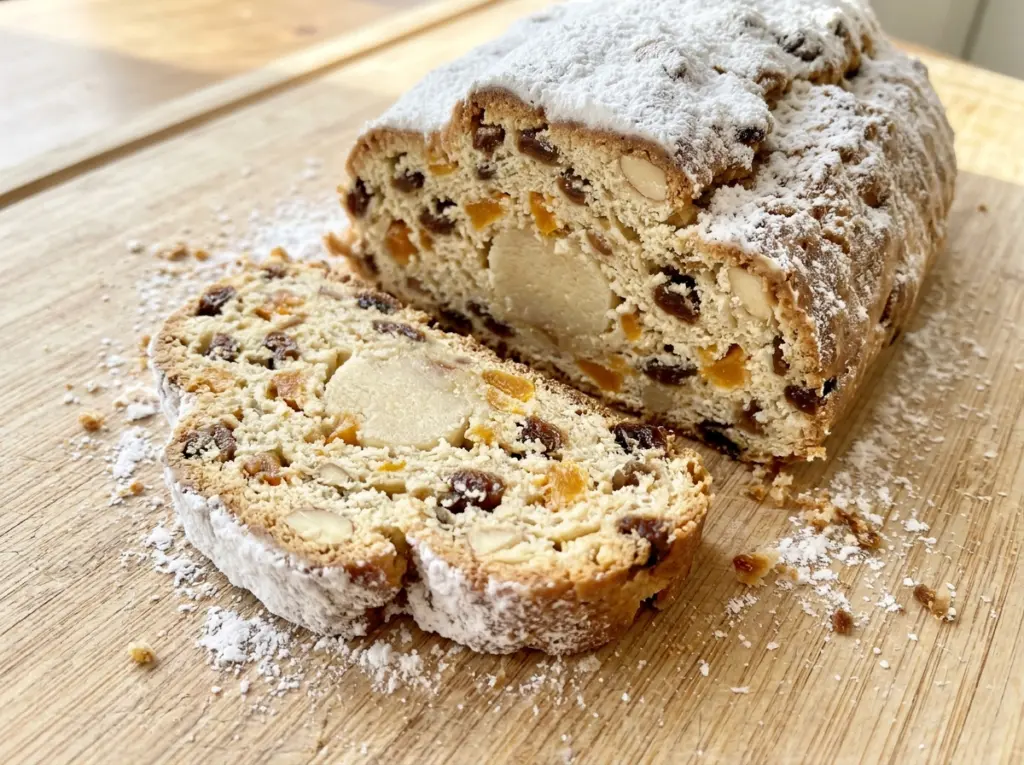
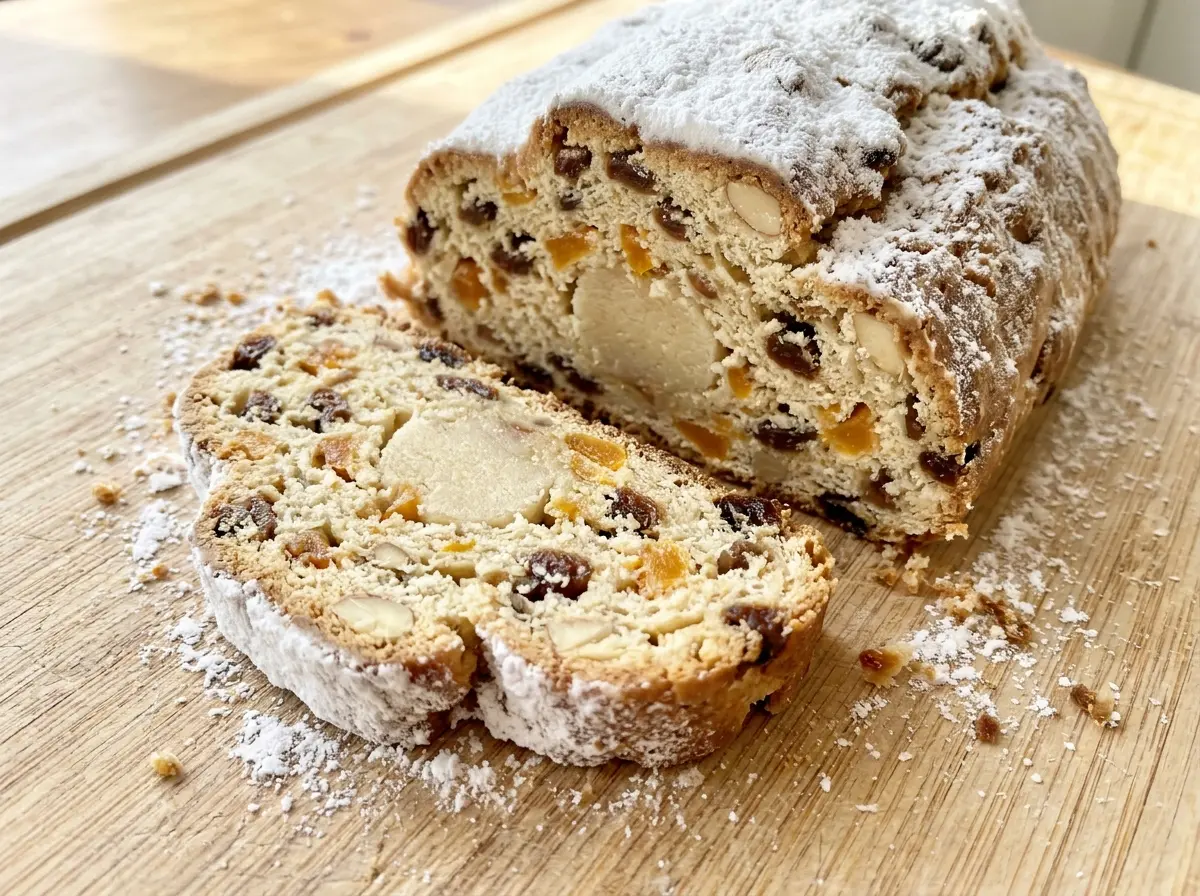
When the buttered loaves come out of the oven, the kitchen smells of citrus, warm spice, and toasted almonds. Christmas stollen has a richer, breadier dough than a quick holiday loaf, and the marzipan tucked inside gives each slice a soft almond center. I like that this version makes two loaves, so there’s one to slice now and another to wrap for later.
The dough should feel smooth and elastic after kneading, but it shouldn’t turn dry or stiff. I add the softened butter gradually, then work in the fruit and almonds once the dough has developed. The marzipan sits slightly off center under a fold of dough, leaving the traditional uneven ridge along the top. Finished with melted butter and two passes of powdered sugar, each loaf has a tender crumb under its snowy coating.
Kitchen Note
Don’t drain the fruit after it soaks. Knead in the raisins, orange peel, and any liquid left in the bowl so that citrusy rum or orange juice reaches the dough instead of being poured down the sink.
Save this Christmas Stollen with Marzipan for its tender fruit-studded crumb and soft almond center.
Why Stollen Gets Two Coats of Powdered Sugar
The sugar finish does more than make the loaves look snowy. Brushing melted butter over the hot bread gives the first sifted layer something to cling to, while the final dusting after cooling restores a pale, powdery surface. Put all the sugar on at once and you miss that layered finish; the warm loaf takes up some of the first coating as it settles.
There’s a useful contrast here: the melted butter adds richness, while the powdered sugar keeps the outside delicate rather than forming a hard glaze. Sift the sugar over the whole loaf, including the sides, instead of concentrating it on the crown. Once the loaves are completely cool, the last dusting brightens the ridges and the exposed strip of dough. That simple two-stage finish is what gives homemade stollen its soft, snowy look without covering up the folds.
What Gives This Stollen Its Fruit, Spice, and Almond Character

- Raisins and candied orange peel — The raisins bring concentrated sweetness, while the peel gives the loaf its distinct citrus notes. Chop the peel finely so it spreads through the dough instead of gathering in large sticky pieces. Dark rum gives the fruit a deeper aroma; orange juice keeps the soak alcohol-free and makes the citrus taste brighter.
- Active dry yeast and warm milk — The milk wakes the yeast, and the foamy mixture is a visible sign that fermentation has started. Keep the milk within the stated warm range; hotter liquid can damage the yeast, while cool milk can slow it down. Active dry yeast is the type used here, so don’t swap in another form without adjusting the method.
- All-purpose flour, eggs, and butter — These form a soft, enriched dough rather than a lean, crusty bread. Spoon and level the flour so it doesn’t get packed into the measuring cup; too much flour can leave the finished loaf heavy. Softened butter kneads in more evenly than cold butter, and the eggs help give the crumb its tender structure.
- Cardamom, cinnamon, lemon zest, and vanilla — The spices bring warmth without drowning out the fruit, while lemon zest adds a fresher citrus note alongside the candied peel. Finely grate the zest so it disperses through the dough, and use fresh, fragrant spices if yours have been open for a long time.
- Marzipan and sliced almonds — Marzipan creates the soft, sweet center that distinguishes this stollen; sliced almonds add a little crunch among the fruit. Keep the marzipan in the recipe if you want that signature filling. It isn’t interchangeable with almond paste, which has a different sweetness and texture.
- Butter and powdered sugar for finishing — Unsalted butter lets you control the dough’s salt, and melted butter carries the first layer of sugar over the crust. Powdered sugar is the right choice for the soft finish; granulated sugar won’t give the same fine coating.
From Soaked Fruit to Two Marzipan-Filled Loaves
Soak the fruit and wake the yeast
Stir the raisins and finely chopped candied orange peel together with dark rum or orange juice, then let them soak for 30 minutes. In a separate small bowl, stir the warm milk, active dry yeast, and a spoonful of the sugar together. Give the mixture 5–10 minutes to turn foamy before using it. If it stays flat, pause here rather than mixing inactive yeast into the dough.
Knead the dough until it turns elastic
Whisk the flour with the remaining sugar, salt, cardamom, and cinnamon, then mix in the yeast mixture, eggs, lemon zest, and vanilla until a shaggy dough forms. Knead in the softened butter a tablespoon at a time; adding it gradually keeps the dough from feeling slick and separated. Continue kneading for 8–10 minutes until the dough is smooth and elastic but still slightly tacky. Work in the soaked fruit and almonds until they’re evenly distributed.
Shape the loaves around the marzipan
Let the covered dough rise in a warm place for 1–1½ hours, until it has doubled. Divide the marzipan into two pieces and roll each into a log about 9 inches long, then divide the dough in half and pat each portion into a 10×8-inch oval. Set a log lengthwise slightly off center, fold one long side over it, and pinch the ends closed while leaving a narrow strip of dough exposed on the other side. Place both loaves seam-side down on the lined baking sheet and let them rise loosely covered for 45–60 minutes, until puffy.
Bake through and finish the crust
Heat the oven to 350°F and line an 18×13-inch rimmed baking sheet with parchment. Bake the loaves for 35–45 minutes, until deep golden brown and 190°F in the centers; tent them loosely with foil if the tops brown too quickly. Brush the hot loaves all over with melted butter and sift half of the powdered sugar over them. Transfer them to a wire rack to cool completely, then sift the remaining sugar over the tops.
Two Simple Ways to Change the Fruit and Crunch
Use orange juice for a brighter fruit soak
Choose orange juice instead of dark rum for the fruit. The soaked raisins and peel will taste more citrus-forward, without the deeper aroma the rum brings.
Leave out the sliced almonds
Omit the almonds if you prefer a softer crumb without the bits of crunch. The marzipan still contains almonds, so this change does not make the loaf suitable for someone avoiding almonds.
Storage and Reheating
- Refrigerator: Refrigeration isn’t necessary and can dry the bread out. Keep the cooled loaves well wrapped at room temperature and enjoy within 4 days.
- Freezer: Wrap a whole cooled loaf or individual slices tightly, then freeze for up to 2 months. Thaw while still wrapped so the surface doesn’t dry out.
- Reheating: Stollen is good at room temperature. To warm a slice, microwave it for about 10 seconds; longer heating can dry the crumb and soften the marzipan too much.
Questions That Come Up When Baking Stollen
Christmas Stollen with Marzipan
Ingredients
Equipment
Method
- Combine the raisins, candied orange peel, and rum or orange juice in a small bowl.
- Let the fruit soak for 30 minutes.
- Stir the warm milk, yeast, and 1 tablespoon of the sugar together in a small bowl.
- Let stand for 5–10 minutes, until foamy.
- Whisk the flour, remaining sugar, salt, cardamom, and cinnamon in a large bowl.
- Mix in the yeast mixture, eggs, lemon zest, and vanilla until a shaggy dough forms.
- Knead in the softened butter a tablespoon at a time.
- Knead for 8–10 minutes until the dough is smooth and elastic but still slightly tacky.
- Add the soaked fruit and any liquid left in the bowl along with the almonds.
- Knead until evenly distributed.
- Cover the bowl.
- Let the dough rise in a warm place for 1–1 1/2 hours, until doubled in size.
- Divide the marzipan into 2 equal pieces.
- Roll each piece into a log about 9 inches long.
- Heat the oven to 350°F.
- Line an 18x13-inch rimmed baking sheet with parchment paper.
- Turn the dough onto a clean counter and divide it in half.
- Pat each half into a 10x8-inch oval.
- Place a marzipan log lengthwise slightly off center on each oval.
- Fold one long side of dough over the log and pinch the ends closed, leaving a narrow strip of dough exposed along the other side.
- Set the loaves seam-side down on the baking sheet.
- Cover loosely.
- Let rise for 45–60 minutes, until puffy.
- Bake for 35–45 minutes, until deep golden brown and the centers reach 190°F; tent loosely with foil if the loaves brown too quickly.
- Brush the hot loaves all over with the melted butter.
- Sift 1/2 cup of the powdered sugar over them.
- Transfer the loaves to a wire rack and cool completely.
- Sift the remaining 1/2 cup powdered sugar over them.