
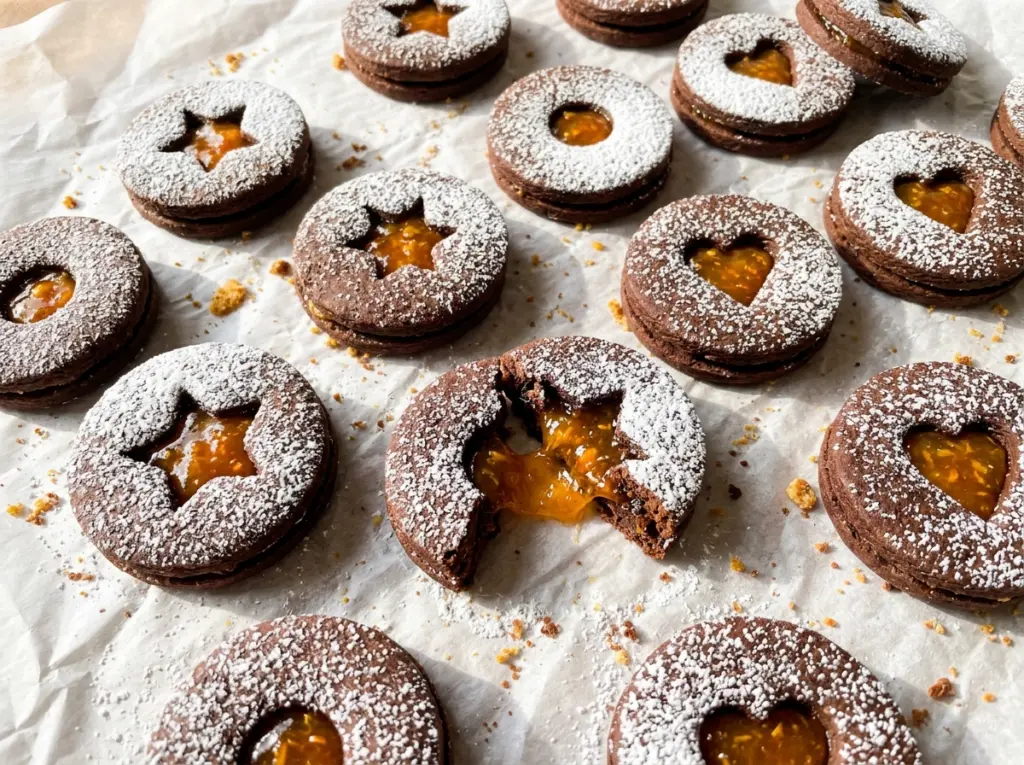
The little center cutouts are the first clue these aren’t ordinary chocolate cookies. The dough is dark and tender, and the finished tops get a snowy layer of powdered sugar before they’re paired with orange marmalade. I like that the chocolate keeps the sweetness in check, while the orange gives each bite a bright, fruity finish.
These chocolate orange Linzer cookies have orange in two places, so the citrus doesn’t disappear behind the cocoa: finely grated zest goes into the dough, and marmalade sits between the cookies. The dough is easy to handle once it’s chilled firm, and rolling it between parchment keeps the cocoa from coating the counter. Set out a cup of tea, and you’ve got a crisp-edged cookie with a soft, fragrant center.
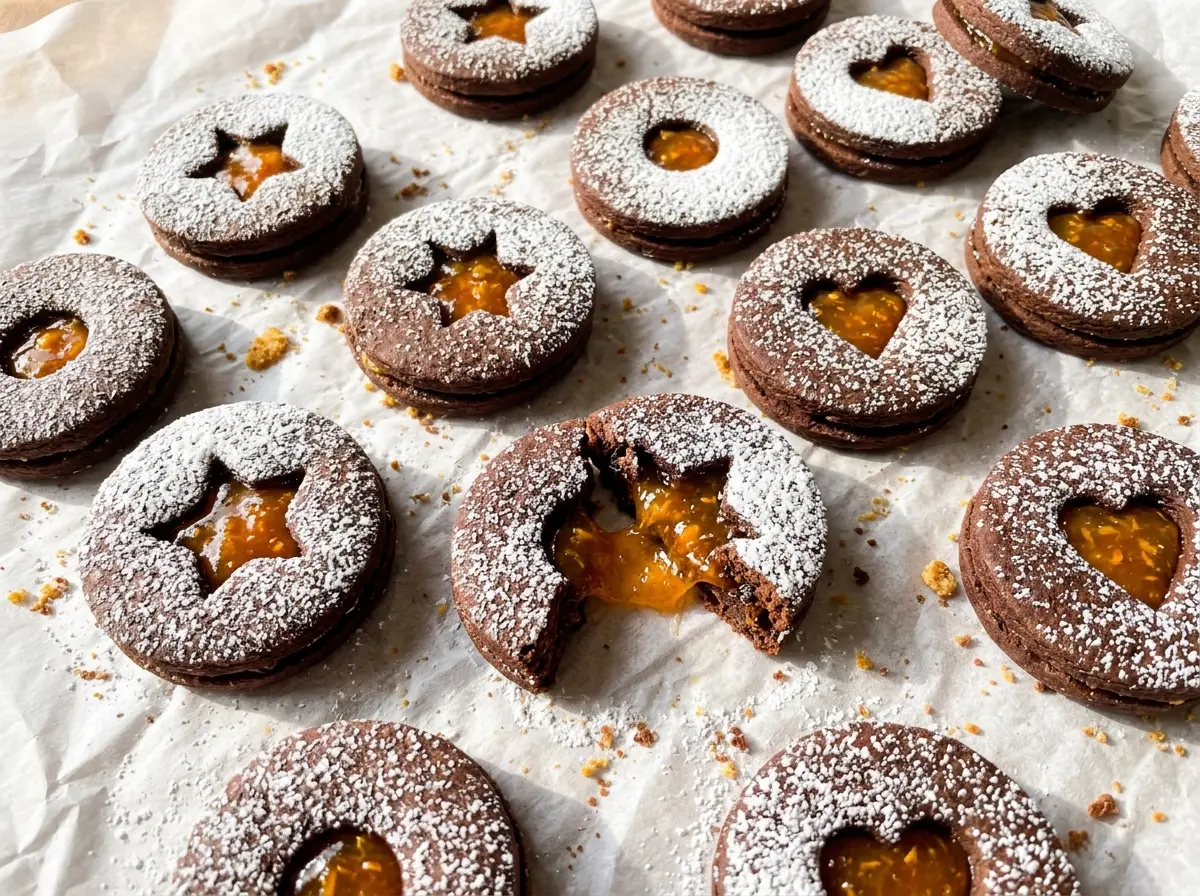
Kitchen Note
Keep the marmalade layer thin—about a teaspoon on each solid cookie is enough. A thicker spread squeezes out when you set the sugared top in place, and the cookies are harder to pick up neatly.
Save these chocolate orange Linzer cookies for a bake with crisp cocoa edges, sugared cutouts, and a bright marmalade center.
Why These Cookies Need Orange in Both the Dough and the Middle
Cocoa can easily crowd out a delicate citrus note. Putting orange zest in the dough spreads its aroma through every chocolate cookie, while marmalade gives the assembled cookie a more concentrated, fruity center. The two forms do different jobs, which is why the orange still registers after the cocoa and butter have had their say.
The cutout design helps that contrast come through, too. You see the marmalade through the little window before you take a bite, and the powdered sugar on top adds a light sweetness against the darker cookie. Keep the chocolate dough unsweetened apart from the granulated sugar in the mix; sweetened cocoa would throw off the balance. These are rich cookies, but the orange keeps them from tasting one-note.
There’s also a practical advantage to making separate solid and cutout cookies. The marmalade stays tucked between two baked layers rather than being exposed across the whole surface, and the top remains easy to dust before assembly. That gives each cookie a clear chocolate-orange contrast without burying the citrus under a thick layer of filling.
What Makes the Chocolate Dough Tender and the Orange Filling Stand Out

- Butter and egg yolk — Softened unsalted butter creams smoothly with the sugar, and the yolk enriches the dough without adding the extra white of a whole egg. Use butter that’s softened but not melted; a standard supermarket butter works well here. If you only have salted butter, leave out the fine salt.
- All-purpose flour and almond flour — All-purpose flour gives the cookies enough structure to hold their cutout shape; almond flour brings a fine, tender crumb that straight all-purpose flour won’t replicate. Use finely ground almond flour rather than coarse almond meal for a smoother dough. Finely ground hazelnut flour is the closest same-amount alternative, with a toastier, more pronounced nut flavor.
- Unsweetened cocoa powder — Cocoa supplies the deep chocolate taste and dark color. Choose a cocoa you enjoy tasting on its own; either natural or Dutch-process unsweetened cocoa works in this dough, and the everyday grocery-store kind is fine. Sweetened hot chocolate mix isn’t a substitute.
- Orange zest and vanilla — Grate only the orange’s colored outer peel; the white pith beneath it can taste bitter. A fine grater gives the zest a texture that blends into the dough without leaving chewy strips. Fresh orange zest matters more here than an expensive vanilla, since the orange is the distinct aromatic note.
- Orange marmalade — A thick marmalade stays in place when the tops are added. The peel contributes a pleasantly bitter edge alongside the sweet fruit, so choose one whose flavor you like; a smoother marmalade is easier to spread, while one with more peel gives a chunkier center.
- Powdered sugar — Sifting it over the cutout cookies gives an even, fine coating without clumps. Powdered sugar is the right choice for this finish; granulated sugar won’t cling in the same soft layer.
Chill, Cut, and Bake the Cookies Without Losing Their Shape
Cream the butter and bring the dough together
Beat the softened butter and granulated sugar on medium until creamy, about 2 minutes. Mix in the egg yolk, vanilla, and orange zest until combined. Whisk the all-purpose flour, almond flour, cocoa, and salt in a separate bowl, then add that mixture on low speed just until a dough forms. Stop when the dry streaks disappear; mixing well past that point can make a tender cookie tougher.
Chill the disks until firm
Divide the dough in half, shape each portion into a disk, wrap it, and refrigerate for at least 1 hour. The dough should feel firm rather than sticky when you unwrap it. Chilling gives the butter time to firm up, which makes the dough much easier to roll and cut cleanly. Keep the second disk chilled while you work with the first.
Roll and cut matching tops and bottoms
Heat the oven to 350°F and line an 18×13-inch baking sheet with parchment. Roll one disk between sheets of parchment to 1/4 inch thick, cut 2-inch rounds, then make 1-inch centers in half of them. Reroll the scraps once; extra handling can leave the last cookies less tender. Arrange the rounds about 1 inch apart on the prepared sheet.
Bake until the edges are set
Bake the cookies for 9–11 minutes, until the edges look set and the tops look dry. Cocoa makes it hard to judge doneness by color, so watch those surface cues rather than waiting for a golden edge. Let the cookies rest on the baking sheet for 5 minutes before moving them to a wire rack. Cool the baking sheet before baking the remaining cookies so the next batch doesn’t start on a hot pan.
Dust, fill, and sandwich
Let the cookies cool completely before assembling; warm cookies are fragile and the marmalade will slide around. Sift powdered sugar over the cookies with the cutout centers, then spread about 1 teaspoon of marmalade on each solid cookie. Set a sugared top over each filled base, lining up the edges gently rather than pressing hard. The filling should show through the center without spilling out at the sides.
Three Ways to Change the Flavor or Fit a Dietary Need
Use hazelnut flour for a toastier cookie
Replace the almond flour with the same amount of finely ground hazelnut flour. The cookies keep their tender texture, but the nut flavor becomes more noticeable beside the cocoa.
Make the cookies dairy-free
Use a dairy-free baking stick in place of the butter, choosing a stick-style product rather than a soft tub spread. The cookies will still have a buttery-style richness, though the flavor may be less rounded than with dairy butter. This adaptation still contains egg.
Make them gluten-free
Replace the all-purpose flour with a cup-for-cup gluten-free baking blend designed for cookies. A blend that includes xanthan gum gives the cutouts better structure; handle the rolled dough gently because gluten-free rounds can be more delicate.
Storage and Reheating
- Refrigerator: Store assembled cookies in an airtight container for up to 3 days. The cookies soften a little as the marmalade sits between them.
- Freezer: Freeze the cooled, unfilled cookies in airtight layers with parchment between them for up to 2 months. Thaw at room temperature, then dust and fill before serving.
- Reheating: These cookies are best at room temperature and don’t need reheating. Warming them can soften the cookies and make the marmalade run.
Questions That Come Up When Making Chocolate Orange Linzer Cookies
Chocolate Orange Linzer Cookies
Ingredients
Equipment
Method
- Beat the butter and granulated sugar with an electric mixer on medium speed until creamy, about 2 minutes.
- Beat in the egg yolk, vanilla extract, and orange zest until combined.
- Whisk together the all-purpose flour, almond flour, cocoa powder, and salt in a medium bowl.
- Add the dry ingredients to the butter mixture and mix on low just until a dough forms.
- Divide the dough in half, shape each half into a disk, wrap, and refrigerate until firm, at least 1 hour.
- Heat the oven to 350°F and line an 18x13-inch baking sheet with parchment paper.
- Working with one disk at a time, roll the dough between sheets of parchment to 1/4 inch thick.
- Cut 2-inch rounds, then cut 1-inch centers from half of the rounds.
- Reroll the scraps once.
- Arrange the cookies on the prepared baking sheet about 1 inch apart.
- Bake for 9–11 minutes, until the edges are set and the tops look dry.
- Cool the cookies on the baking sheet for 5 minutes, then transfer them to a wire rack to cool completely.
- Let the baking sheet cool before baking the remaining cookies.
- Sift the powdered sugar over the cookies with cutout centers.
- Spread about 1 teaspoon of orange marmalade on each solid cookie and top with a sugared cookie.