
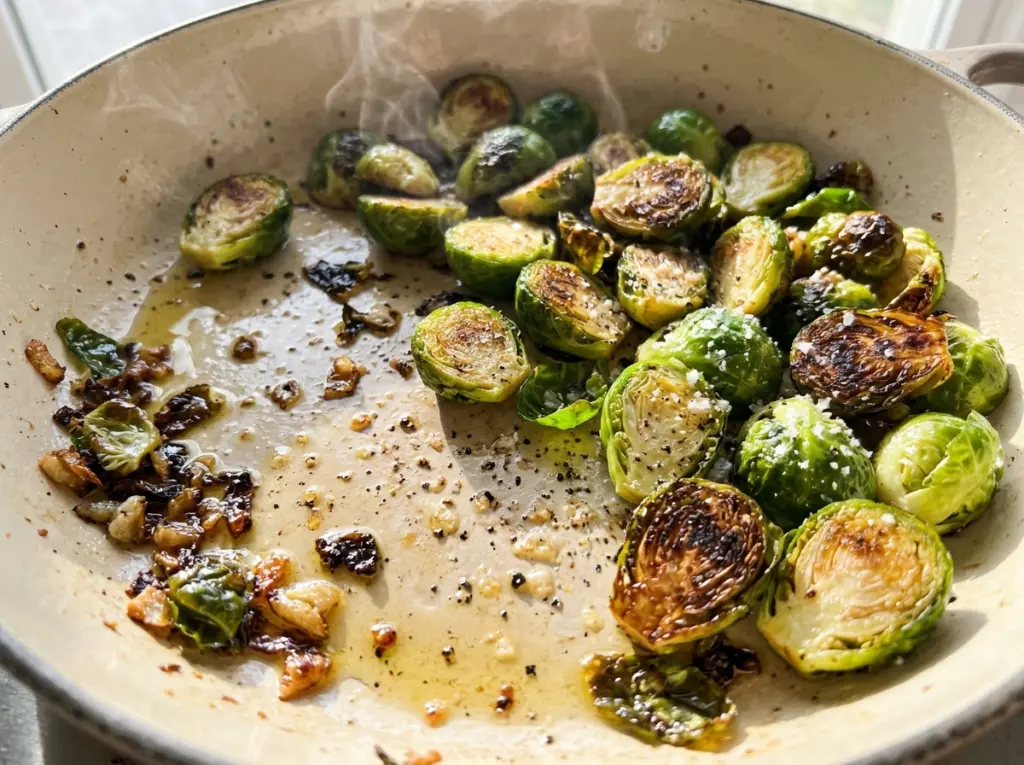
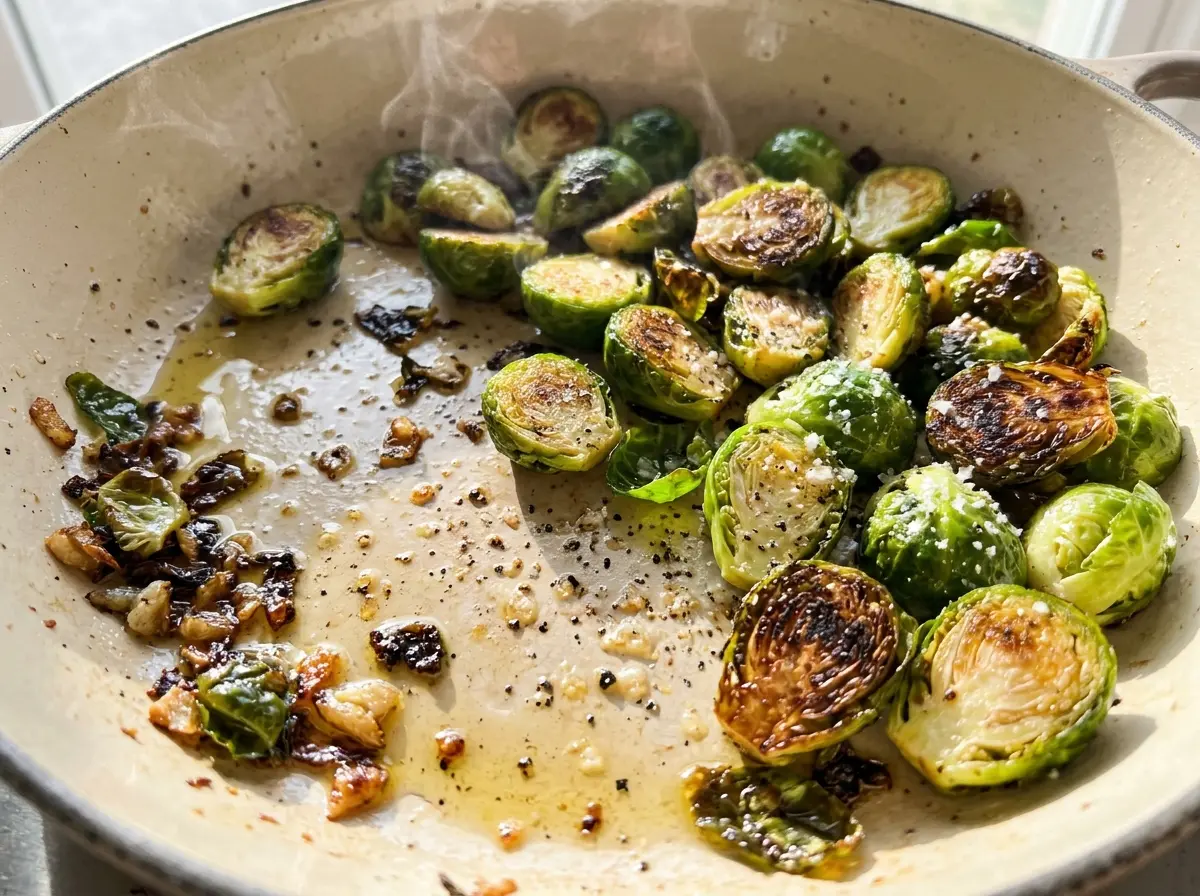
The first thing you notice is the sound: the sprouts hit the hot pan, and the kitchen starts to smell nutty as their cut sides brown. Brussels sprouts can turn soft before they taste sweet, but a hot oven and room for the sprouts to roast help them develop deep color while the centers become tender.
I make these caramelized Brussels sprouts with just olive oil, kosher salt, and black pepper. Halving them lengthwise gives each sprout a broad surface to brown, and arranging that surface against the pan does the work without extra ingredients or a complicated sauce.
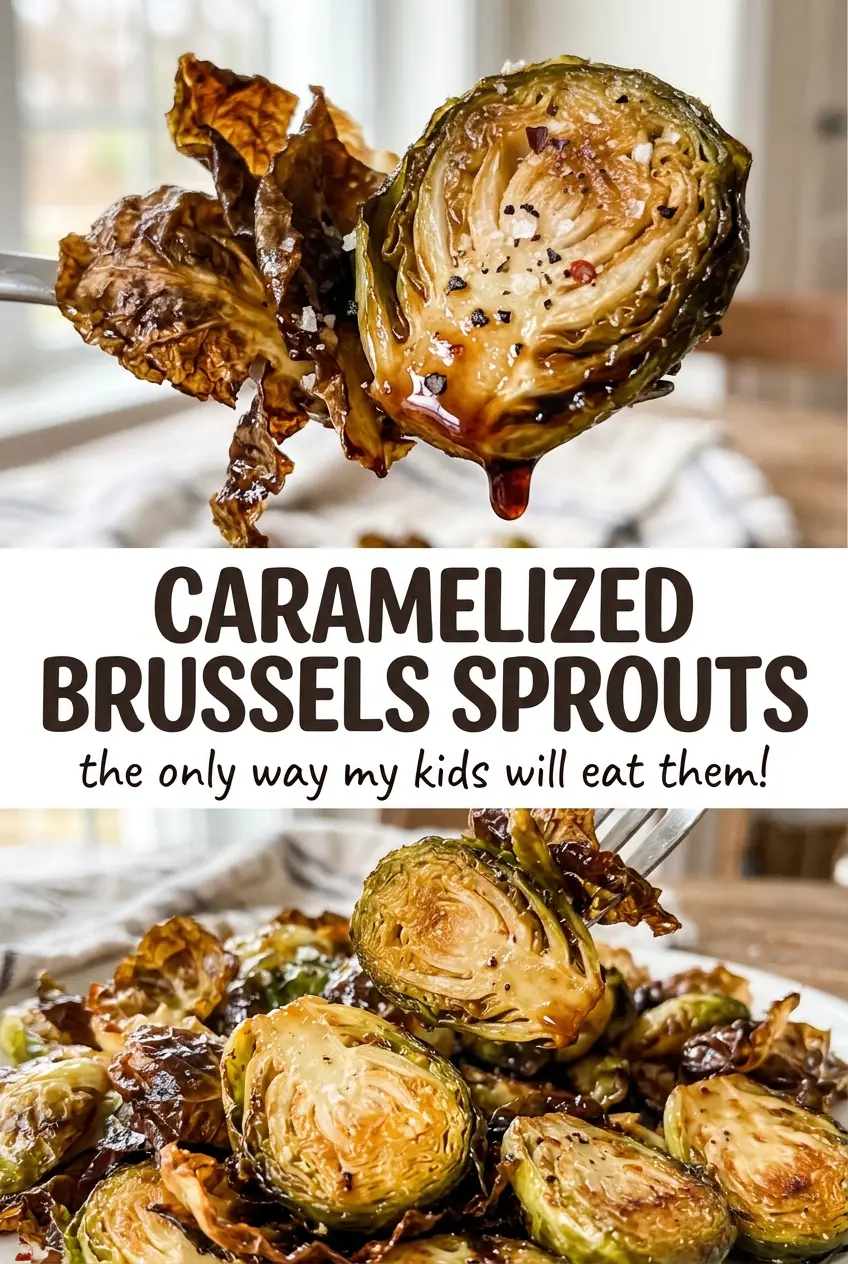
The finished sprouts have browned edges, tender centers, and a straightforward savory flavor. They’re a simple side dish, but the contrast between the deeply roasted cut faces and the softer leaves is what makes each bite interesting.
Kitchen Note
Give the oven time to reach 425°F before the pan goes in. A fully heated oven gets the roasting started right away, instead of leaving the sprouts to soften while the temperature climbs.
Save these caramelized Brussels sprouts for a simple side with deeply browned edges and tender centers.
Why the Cut Side Needs Direct Contact With the Pan
Brussels sprouts are compact, and their rounded sides don’t offer much flat area for browning. Cutting them in half creates a wide face; putting that face against the baking sheet gives it steady contact with the hot surface. That’s where the darkest, most concentrated browning develops.
Spacing matters for the same reason. When the halves sit in a single layer instead of piled together, moisture can escape rather than collecting around the vegetables. A crowded pan is more likely to leave you with soft, pale sprouts. Keep the pieces cut side down and give them a little room, even if arranging them takes an extra moment.
There’s no need to stir them during roasting. Leaving the cut faces in place lets them brown undisturbed, while the heat works through the sprouts until they’re tender. Look for a deep brown color on those flat sides, not just a little golden tint; that roasted surface gives the mild, slightly bitter vegetable its characteristic caramelized taste.
What Each Ingredient Contributes to These Roasted Sprouts
- Brussels sprouts — Choose firm sprouts with compact leaves and a fresh appearance. Similar-sized sprouts roast more evenly, so halve larger ones lengthwise and keep the pieces reasonably consistent. Trimming the stem ends removes the dry base while keeping the leaves attached.
- Olive oil — A light coating helps carry the seasoning across the leaves and supports browning in the oven. A standard olive oil works well here; there’s no need to use a prized finishing oil because its more delicate character won’t be the focus after roasting. I keep olive oil for the recipe’s familiar savory taste rather than suggesting a substitute that would change it.
- Kosher salt — Salt seasons the vegetable itself, not just the browned exterior, so tossing everything together in a bowl helps distribute it. I use kosher salt as listed; fine table salt is denser by volume, so it isn’t a direct volume-for-volume swap.
- Black pepper — Black pepper adds a gentle, warm bite that balances the sprouts’ natural bitterness. Freshly ground pepper has a livelier aroma, but ordinary ground black pepper is fine for this simple roast.
The Three Stages That Bring Out the Browned Edges
Heat the Oven and Prepare the Pan
Set the oven to 425°F and line a large rimmed baking sheet with parchment paper. Let the oven finish preheating before the sprouts go in; an oven that’s still warming won’t give you the same immediate roasting conditions. The rim around the sheet helps contain the vegetables as you arrange them.
Coat the Halved Sprouts Evenly
Put the trimmed, halved sprouts in a large bowl with the olive oil, kosher salt, and black pepper. Toss until the pieces look evenly coated, with no dry patches of seasoning sitting at the bottom of the bowl. If the oil and seasonings cling mostly to a few pieces, give the bowl another toss before moving on.
Arrange Cut Side Down and Roast
Place the sprouts in one layer on the prepared baking sheet, with each flat cut surface against the pan. Roast for 22 to 28 minutes, until those sides are deeply browned and the sprouts are tender. The exact point within that window depends on the size of the halves, so judge by the color and tenderness rather than expecting every batch to finish at the same minute.
Two Practical Ways to Adapt the Sprouts Without Changing the Roast
A naturally dairy-free and gluten-free side
The listed ingredients already make this a plant-based side without dairy or gluten-containing ingredients, so no replacement is needed. Keeping the seasoning simple lets the roasted sprouts stay the focus; the tradeoff is that this version doesn’t have a creamy or cheesy finish.
Serve chilled as a leftover side
Once refrigerated, the sprouts can be served cold instead of reheated. Their centers become firmer and the cut faces lose some of their freshly roasted texture, but the browned, savory flavor still comes through. This is a useful change of format for leftovers, not a substitute for the crisp-edged result straight from the oven.
Storage and Reheating
- Refrigerator: Store in a covered container for 3 to 4 days. The browned surfaces soften as the sprouts sit.
- Freezer: They can be frozen in an airtight container for up to 2 months, though thawed sprouts will be softer than freshly roasted ones.
- Reheating: Spread them in a single layer on a baking sheet and warm in the oven until hot. Microwaving is quick, but it softens the browned edges further.
Questions That Come Up Before the Pan Goes in the Oven
Caramelized Brussels Sprouts
Ingredients
Equipment
Method
- Preheat the oven to 425°F.
- Line a large rimmed baking sheet with parchment paper.
- Toss the Brussels sprouts with the olive oil, kosher salt, and black pepper in a large bowl until evenly coated.
- Arrange the sprouts cut side down in a single layer on the baking sheet.
- Roast for 22 to 28 minutes, until the cut sides are deeply browned and the sprouts are tender.