
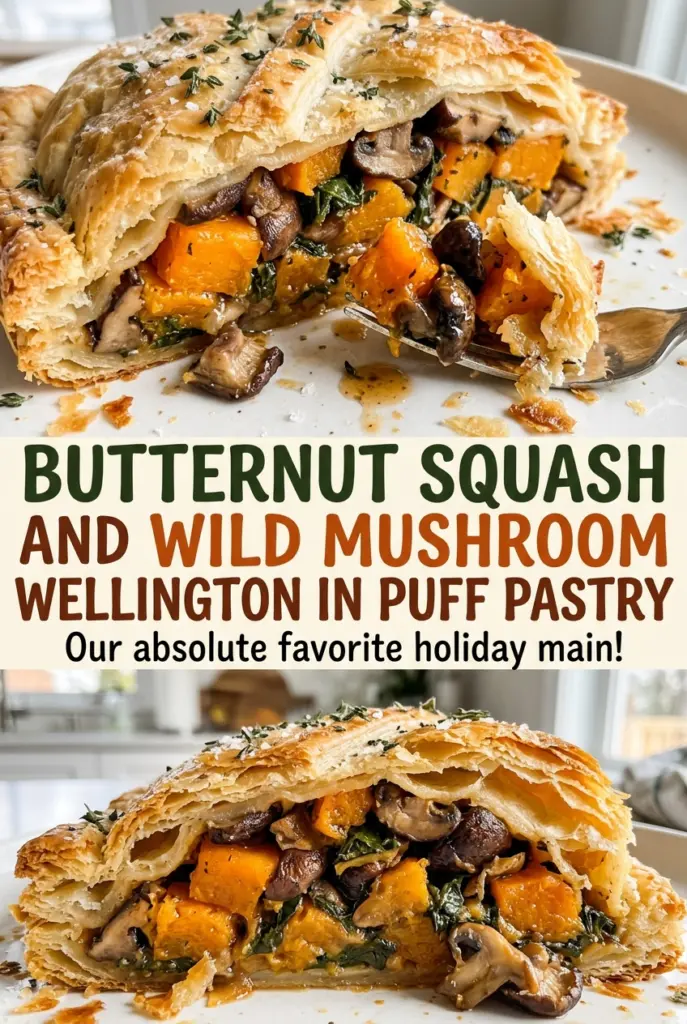
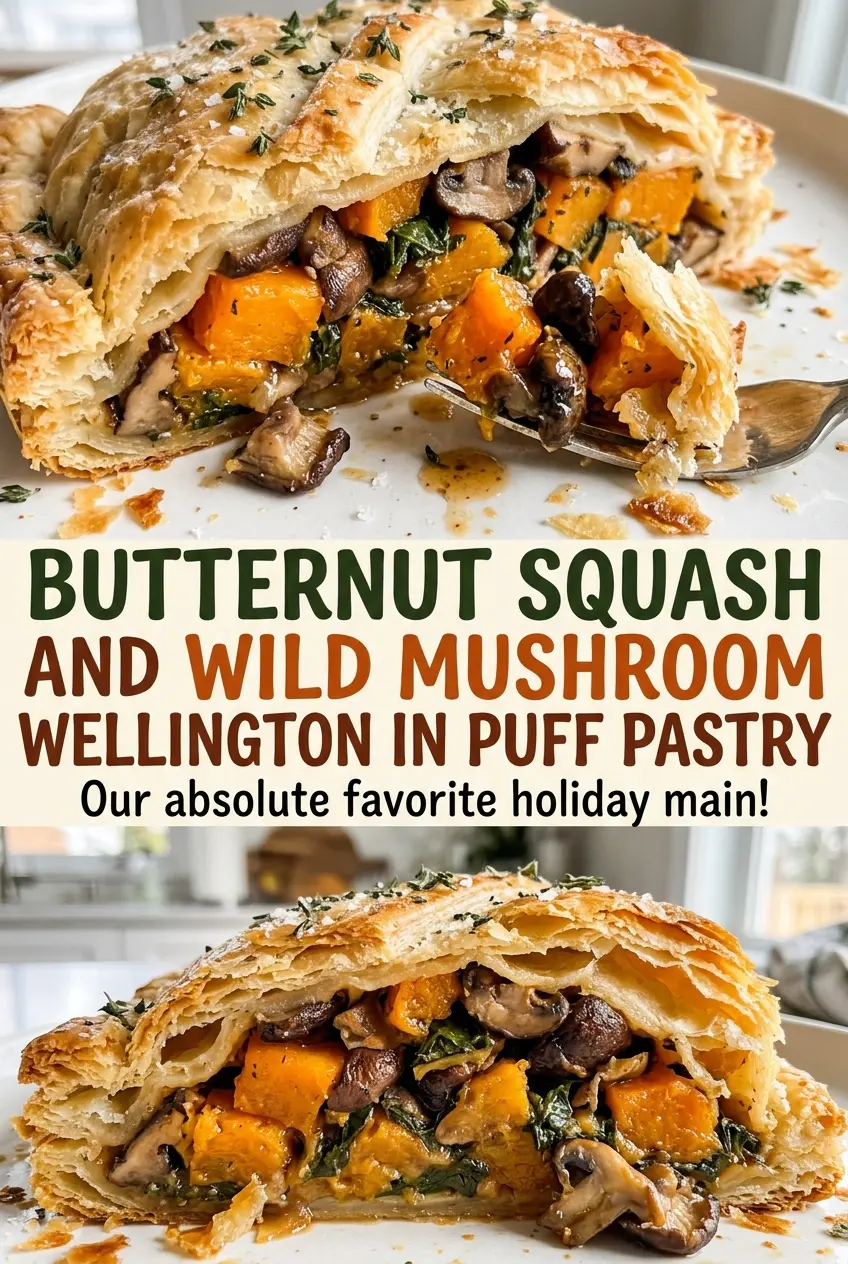
The mushrooms look almost too wet for a pastry filling at first, and that’s the moment I used to get impatient. Give them time in the skillet: the liquid cooks away, the mushrooms turn brown, and the whole Wellington has a much better chance of coming out crisp instead of damp. That patient start is what makes this butternut squash and wild mushroom Wellington feel like a proper centerpiece, even though the filling is built from simple vegetables and herbs.
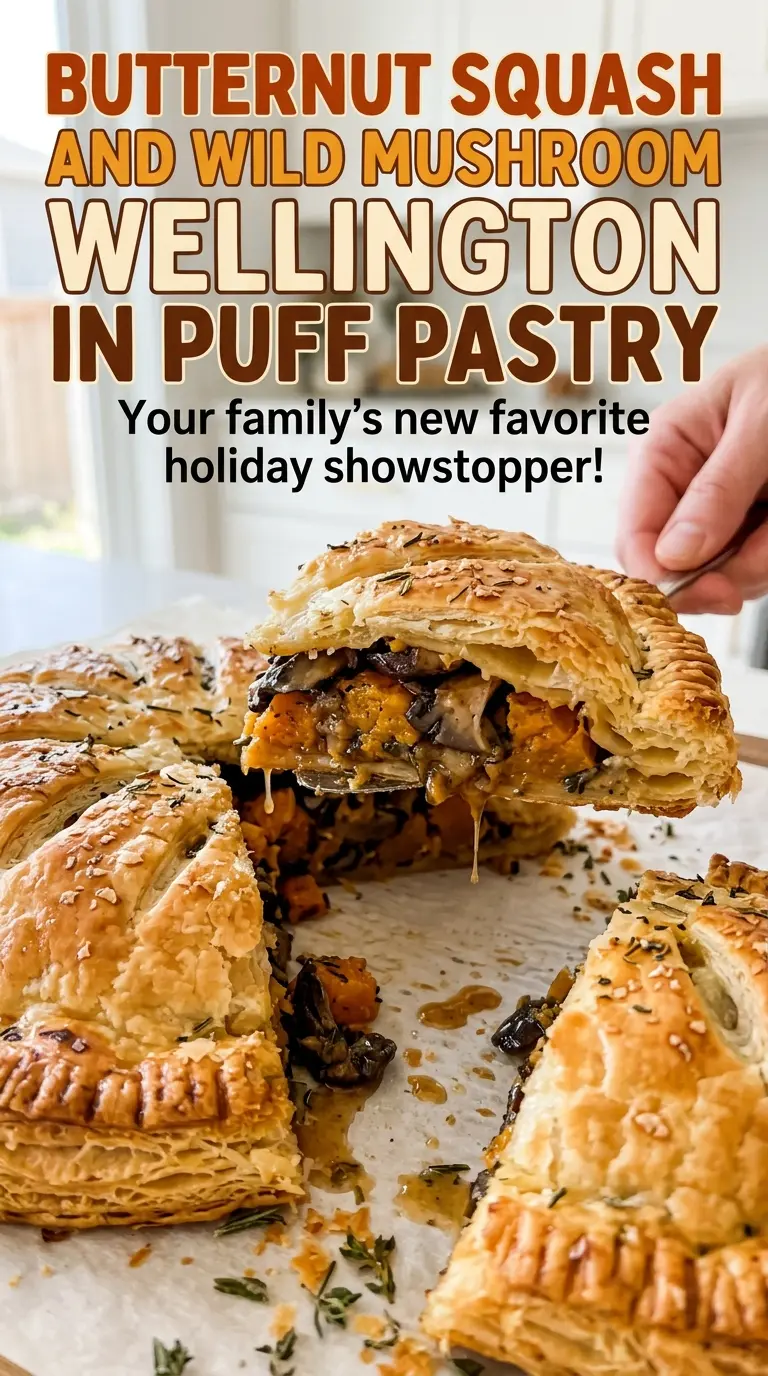
I roast the squash separately so its edges brown instead of softening in the mushroom pan. Then the two meet with panko, which helps the filling hold together without turning it into a purée. The pastry gets rolled into one wide sheet, wrapped around a compact log, and baked until deeply golden. Once rested and sliced, this Wellington serves six with neat layers of flaky pastry, earthy mushrooms, and tender squash.
Kitchen Note
I spread the filling out on a plate rather than leaving it in the skillet to cool. That shallow layer loses heat more evenly, and I wait until it’s completely cool before shaping the log.
Save this butternut squash and wild mushroom Wellington for a flaky, golden centerpiece with a savory vegetable filling.
A Dry Mushroom Filling Is What Keeps the Puff Pastry Crisp
Wild mushrooms release a surprising amount of liquid as they cook. If that moisture is still in the skillet when the filling goes into the pastry, it can turn the bottom layers soft before the top has a chance to crisp. Keep the pan over medium-high heat and stir often; the mushrooms should look browned, with no puddle left in the bottom of the skillet. It takes patience, but it’s more useful than trying to fix a wet filling after it’s wrapped.
Panko goes in after the skillet comes off the heat. It catches the last bit of moisture and gives the filling enough structure to stay in a compact log when you slice it. The squash is folded in gently rather than mashed, so the pieces stay distinct inside the mushroom mixture. Together, those small choices give the pastry a drier filling to surround and slices that hold their shape on the plate.
What the Squash, Mushrooms, and Panko Each Bring
- Butternut squash — Its mild sweetness balances the earthy mushrooms, and uniform half-inch cubes roast at a similar pace. Choose a firm squash; another firm winter squash can stand in, though the sweetness and texture will shift slightly.
- Wild mushroom blend — A mix gives the filling more varied, woodsy flavor, but fresh cremini mushrooms are a practical swap. Finely chop them just as you would the blend; the result will taste a little more straightforward. Fresh mushrooms from the regular grocery store work well.
- Shallots — They bring a gentle onion note without taking over the filling. A finely minced yellow onion works if that’s what you have, though its flavor will be sharper; use a fresh, firm one rather than a soft or sprouting onion.
- Garlic and fresh thyme — Fresh garlic and thyme give the filling a clean, savory lift. If fresh thyme isn’t available, dried thyme works; use about one-third as much as you would fresh, since dried herbs are more concentrated.
- Panko breadcrumbs — Panko stays light in the mixture and helps it slice neatly. Plain dry breadcrumbs can replace it, but they make a somewhat denser filling; avoid seasoned crumbs, which can bring extra salt and competing flavors.
- Puff pastry — The two sheets need to join into one broad wrapper, so check that the package contains two sheets and thaw them before rolling. A standard grocery-store brand is fine; the important thing is that the sheets are intact and pliable enough to press together.
- Egg — The egg beaten with water makes the pastry’s surface glossy and deeply colored. If you need an egg-free finish, brush the pastry with water instead; it will look less shiny and may brown less deeply.
How to Build the Wellington Without a Damp Center
Roast the squash until its edges take on color
Heat the oven to 425°F and line a rimmed baking sheet with parchment paper. Toss the squash with 1 tablespoon of the olive oil, 1/2 teaspoon of the kosher salt, and 1/4 teaspoon of the black pepper, then spread it in one layer. Roast for 25–30 minutes, until the cubes are tender and browned at the edges. Crowding them makes it harder for those edges to brown, so give the pieces room on the pan.
Cook the mushrooms down before adding the aromatics
While the squash roasts, heat the remaining 1 tablespoon of olive oil in a 12-inch skillet over medium-high heat. Add the finely chopped mushrooms and cook for 10–14 minutes, stirring often, until their liquid has evaporated and they’re browned. Add the shallots, remaining salt, and remaining pepper; cook for 3 minutes, then stir in the garlic and thyme for 1 minute. The garlic goes in near the end so it has time to turn fragrant without scorching.
Cool the filling before it meets the pastry
Transfer the roasted squash to a plate and reduce the oven temperature to 400°F. Take the skillet off the heat, stir in the panko, and gently fold in the squash. Spread the filling on a plate and refrigerate until completely cool, about 30 minutes. A warm filling can soften the pastry while you’re assembling it, so don’t shape the Wellington until the filling has cooled through.
Join the pastry sheets and seal the filling inside
Let the baking sheet cool, then line it with fresh parchment. On another large piece of parchment, set the pastry sheets side by side with a 1-inch overlap, press the seam together, and roll them into a 12×16-inch rectangle. Shape the cooled filling into a compact 11-inch log down the center. Brush one long edge with egg wash, fold the opposite edge over the filling, overlap it with the brushed edge, press to seal, tuck the ends underneath, and place the Wellington seam-side down on the lined baking sheet.
Bake until deeply golden, then let the layers settle
Brush the top and sides with the remaining egg wash and cut a few shallow diagonal slashes in the pastry. Bake at 400°F for 35–45 minutes, until the pastry is deeply golden and crisp. If it still looks pale, give it more time rather than pulling it early; the color is a useful cue that the layers have baked through. Rest the Wellington for 10 minutes before slicing.
Two Useful Ways to Adapt This Wellington
Trade the thyme for fresh sage
For a deeper, more autumnal flavor, use finely chopped fresh sage in place of the thyme. Sage is stronger, so start with about half as much; it gives the mushroom filling a more pronounced herbal note without changing the pastry method.
Make it gluten-free with matching pastry and crumbs
Use gluten-free panko and two gluten-free puff pastry sheets in place of the standard versions. The pastry may be more delicate to handle, so assemble it on parchment and press the overlap gently; bake at 400°F, using the deeply golden, crisp surface as your doneness cue.
Storage and Reheating
- Refrigerator: Keep leftover slices in an airtight container for up to 3 days. The pastry will soften as it sits.
- Freezer: Freeze fully cooled slices in a single layer, then wrap them airtight for up to 2 months. Thaw overnight in the refrigerator; the pastry won’t be quite as crisp as it is fresh.
- Reheating: Warm slices on a baking sheet in a 350°F oven for about 10–15 minutes, until hot through. The microwave heats the filling but makes the pastry soft.
Questions That Come Up When Making Wellington
Butternut Squash and Wild Mushroom Wellington in Puff Pastry
Ingredients
Equipment
Method
- Preheat the oven to 425°F.
- Line a rimmed baking sheet with parchment paper.
- Toss the squash with 1 tablespoon of the olive oil, 1/2 teaspoon of the salt, and 1/4 teaspoon of the pepper.
- Spread the squash in a single layer and roast for 25–30 minutes, until tender and browned at the edges.
- While the squash roasts, heat the remaining 1 tablespoon olive oil in a 12-inch skillet over medium-high heat.
- Add the mushrooms and cook for 10–14 minutes, stirring often, until their liquid has evaporated and they are browned.
- Add the shallots, remaining salt, and remaining pepper and cook for 3 minutes.
- Stir in the garlic and thyme and cook for 1 minute.
- Transfer the squash to a plate.
- Reduce the oven temperature to 400°F.
- Remove the skillet from the heat and stir in the panko.
- Gently fold in the squash.
- Spread the filling on a plate and refrigerate until completely cool, about 30 minutes.
- Let the baking sheet cool, then line it with fresh parchment.
- On another large piece of parchment, arrange the pastry sheets side by side, overlapping them by 1 inch.
- Press the seam together and roll the pastry into a 12x16-inch rectangle.
- Shape the cooled filling into an 11-inch-long, compact log down the center of the pastry.
- Beat the egg with the water.
- Brush one long edge of pastry with egg wash.
- Fold the opposite edge over the filling, overlap with the brushed edge, and press to seal.
- Fold the ends under and place the Wellington seam-side down on the lined baking sheet.
- Brush the top and sides with the remaining egg wash.
- Cut a few shallow diagonal slashes in the pastry.
- Bake at 400°F for 35–45 minutes, until the pastry is deeply golden and crisp.
- Rest the Wellington for 10 minutes before slicing.