
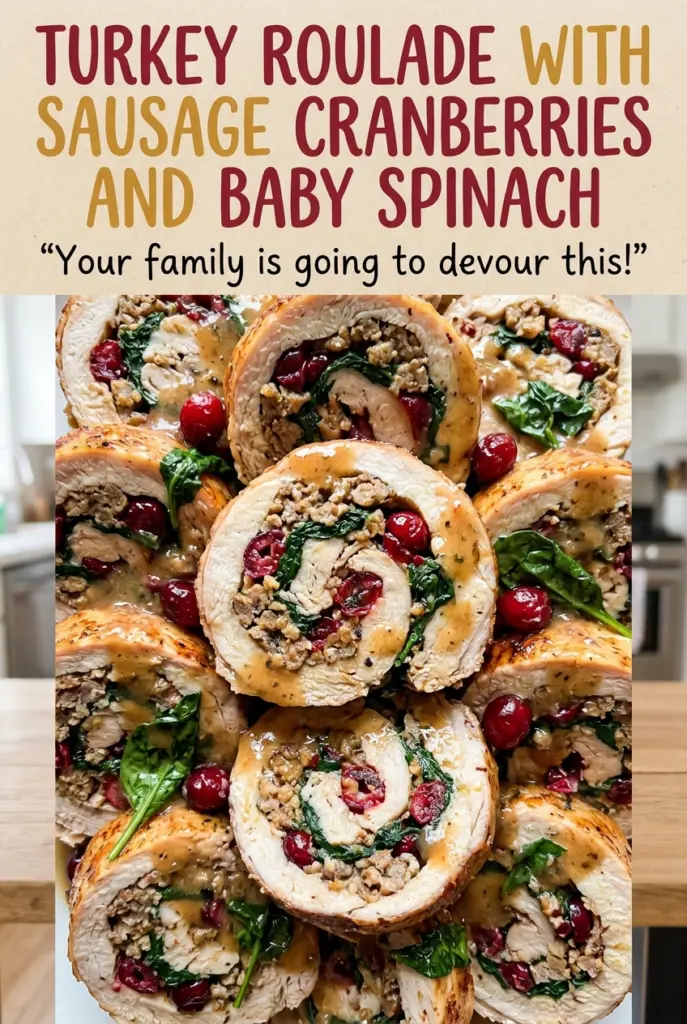
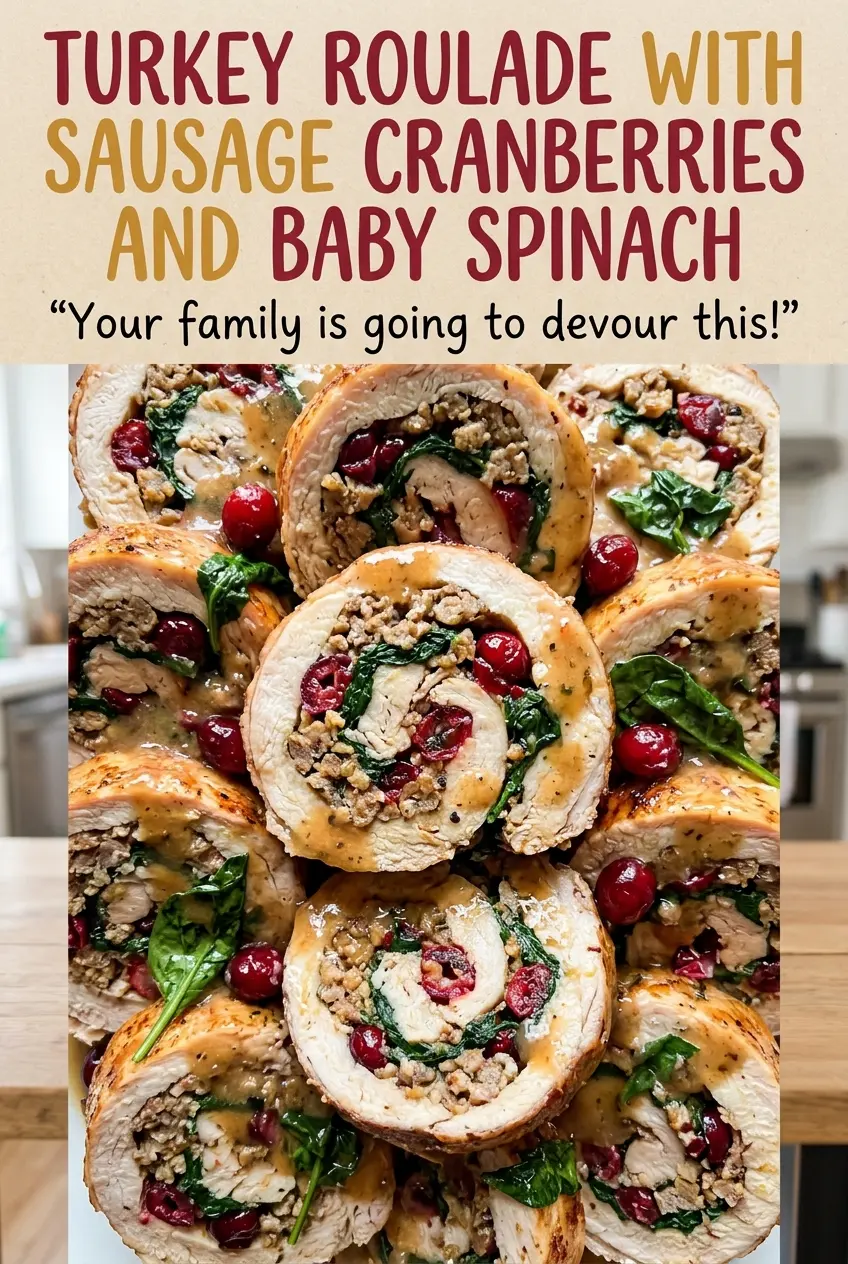
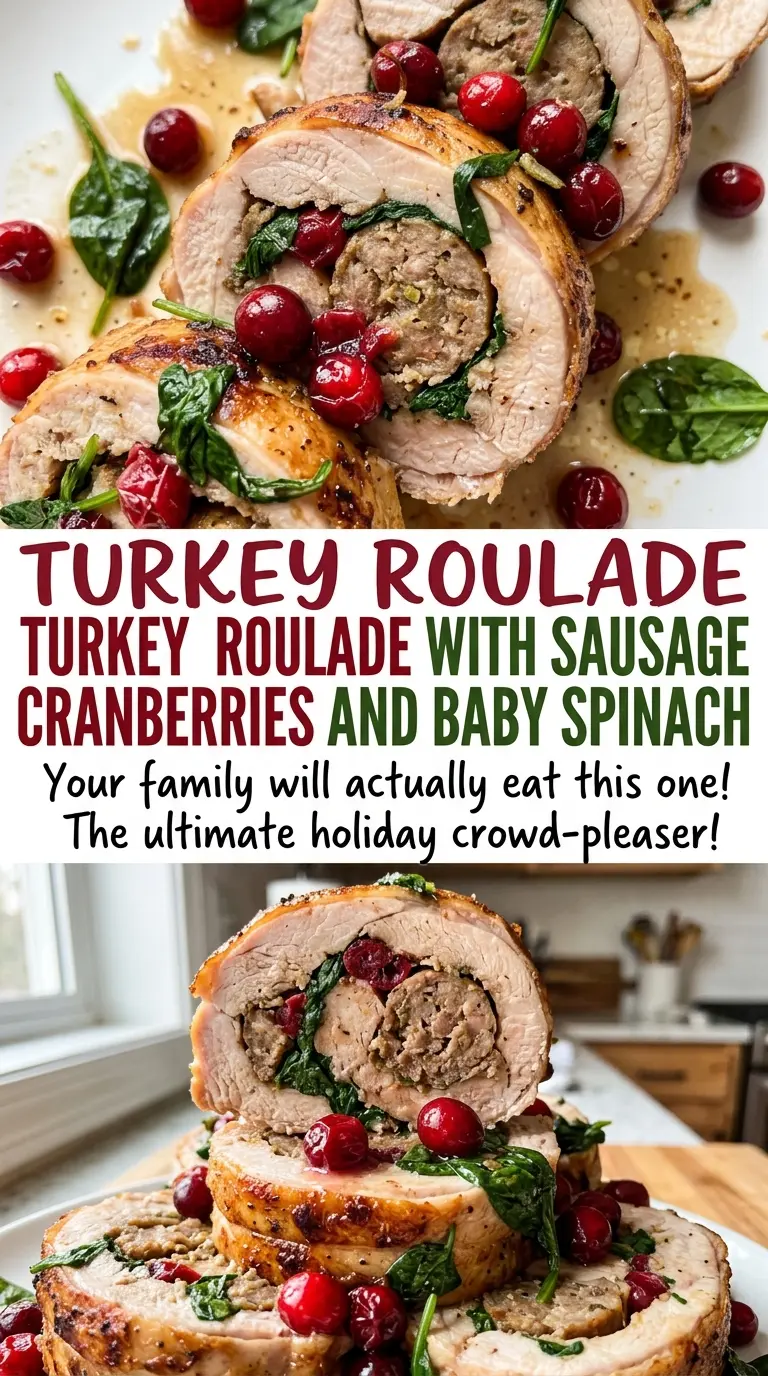
When you slice a stuffed turkey breast, you want a clear spiral—not a pile of filling that slipped out the ends. This roulade layers mild Italian sausage with tart dried cranberries and baby spinach, so each slice has savory, sweet, and tender bites tucked inside. It feels special enough for a holiday table, but the work is mostly straightforward skillet cooking and careful rolling.
I like how the breadcrumbs and egg bring the sausage mixture together without turning it into a dense stuffing. The turkey stays the focus, while the cranberries cut through the richness and the spinach keeps the filling from feeling heavy. Once the roulade is sliced, that colorful center makes the whole roast look like more effort than it took.
Kitchen Note
Let the sausage and spinach mixture cool before the egg goes in. If it is still steaming, the egg can start to set in spots instead of blending evenly through the filling.
Save this sausage-cranberry turkey roulade for a centerpiece roast with a savory, colorful spiral in every slice.
Why an Even Turkey Blanket Matters More Than a Tight Roll
With a roulade, the turkey breast is both the wrapper and the main event. If one end is much thicker than the other, the thinner portion can dry out while you wait for the center to finish cooking. Pounding the butterflied breast to an even thickness gives the heat a more consistent path through the meat, and it makes the finished roll easier to shape.
That even layer also helps the filling stay in a tidy spiral. A very thick section pushes against the filling as you roll, while a thin spot can tear under the same pressure. Aim for an even sheet rather than chasing a perfectly smooth surface; a small irregular edge is fine. The filling should sit in a level layer with a border around it, not in a tall mound down the middle.
This is why a neat, evenly sized roll matters more than pulling the twine as tight as you can. Twine holds the shape while the turkey roasts, but it cannot correct uneven thickness or a lopsided filling. A balanced roll gives you slices with turkey around the filling instead of a loose center and overcooked edges.
What the Sausage, Spinach, and Crumbs Each Bring to the Filling
- Mild Italian sausage — It supplies the filling’s seasoning, savory flavor, and enough fat to keep the mixture from tasting dry. Choose sausage you enjoy on its own; a mild version lets the cranberries stay noticeable rather than competing with strong heat.
- Baby spinach and yellow onion — The onion softens into the sausage as it cooks, while spinach adds a tender, vegetal note. Roughly chopping the spinach makes it easier to distribute through the filling instead of leaving long strands that pull out when you slice.
- Dried cranberries — Their tart sweetness breaks up the richness of the sausage. Keep them dried rather than using fresh cranberries, which would release extra moisture and bring a sharper flavor to this filling.
- Plain dried breadcrumbs and egg — Breadcrumbs absorb some of the moisture and help the filling hold together; the beaten egg binds the mixture. For a gluten-free version, plain gluten-free dried breadcrumbs work in the same volume, though the crumb may feel a little different depending on the brand.
- Boneless, skinless turkey breast — A single butterflied breast gives you one continuous sheet to roll around the filling. Ask the butcher to butterfly it if you would rather not cut it open at home, and check that it is boneless and skinless before you start.
From Skillet Filling to a Secure, Even Roast
Set Up the Baking Dish
Heat the oven to 375°F and line a 9×13-inch baking dish with parchment paper. The parchment keeps the roulade from sticking as the filling settles during roasting. Set the dish nearby before you start shaping so you can transfer the roll seam-side down without having to rearrange the pan.
Brown the Sausage and Soften the Onion
Warm the olive oil in a large skillet over medium heat, then add the sausage and finely chopped onion. Break the sausage into small pieces as it cooks so the browned bits are spread evenly through the filling. Cook for 8-10 minutes, until the sausage is browned and reaches 160°F. If the skillet is crowded with large clumps, keep breaking them up rather than leaving a few big pieces in the center.
Wilt the Spinach and Bind the Filling
Stir in the roughly chopped spinach and cook for 1-2 minutes, just until the leaves wilt. Transfer everything to a large bowl and let it cool for 10 minutes. Stir in the dried cranberries, breadcrumbs, and beaten egg until the mixture looks evenly combined, with no pocket of egg or dry crumbs.
Roll, Tie, and Roast to Temperature
Place the butterflied turkey between sheets of plastic wrap and pound it evenly to about 1/2 inch thick. Season both sides with kosher salt and black pepper, then lay the turkey flat with a long side facing you and spread the filling over it, leaving a 1-inch border. Roll it away from you into a log, set it seam-side down in the prepared dish, and tie it with kitchen twine at 1 1/2-inch intervals. Roast for 55-75 minutes, until both the center of the filling and the thickest part of the turkey reach 165°F. Rest for 15 minutes before removing the twine and slicing.
Three Useful Ways to Adapt the Sausage-Cranberry Filling
Make the filling gluten-free
Replace the plain dried breadcrumbs with the same volume of plain gluten-free dried breadcrumbs. The filling may have a slightly different texture depending on the crumbs, but they still help absorb moisture and hold the sausage mixture together.
Turn up the sausage heat
Swap mild Italian sausage for an equal amount of hot Italian sausage. The rest of the filling stays the same, but the finished slices have a more peppery, assertive bite that stands up to the cranberries.
Trade cranberries for dried cherries
Use an equal amount of chopped dried cherries in place of the cranberries. They keep the chewy fruit contrast but make the filling taste a little less tart and more mellow.
Storage and Reheating
- Refrigerator: Store cooked slices or the remaining roast in a covered container for 3-4 days. The turkey will firm up as it chills, so slices may feel less tender straight from the refrigerator.
- Freezer: Freeze the cooked roulade whole or in slices, wrapped tightly, for up to 2-3 months for best quality. Thaw it in the refrigerator before reheating.
- Reheating: Warm slices covered in the microwave at medium power until hot throughout. High heat can make lean turkey tough before the center warms through.
Questions That Come Up When Rolling and Roasting Turkey Breast
Turkey Roulade with Sausage Cranberries and Baby Spinach
Ingredients
Equipment
Method
- Heat the oven to 375°F.
- Line a 9x13-inch baking dish with parchment paper.
- Heat the olive oil in a large skillet over medium heat.
- Add the sausage and onion; cook for 8-10 minutes, breaking up the sausage, until browned and the sausage reaches 160°F.
- Stir in the spinach and cook for 1-2 minutes until wilted.
- Transfer the mixture to a large bowl and let cool for 10 minutes.
- Stir the cranberries, breadcrumbs, and beaten egg into the cooled sausage mixture until combined.
- Place the butterflied turkey between sheets of plastic wrap and pound it evenly to about 1/2 inch thick.
- Season both sides of the turkey with the salt and pepper.
- Lay the turkey flat with a long side facing you.
- Spread the filling over the turkey, leaving a 1-inch border.
- Roll the turkey away from you into a log.
- Place it seam-side down in the prepared dish.
- Tie it with kitchen twine at 1 1/2-inch intervals.
- Roast for 55-75 minutes, until the center of the filling and the thickest part of the turkey both reach 165°F.
- Rest the roulade for 15 minutes.
- Remove the twine and slice.