
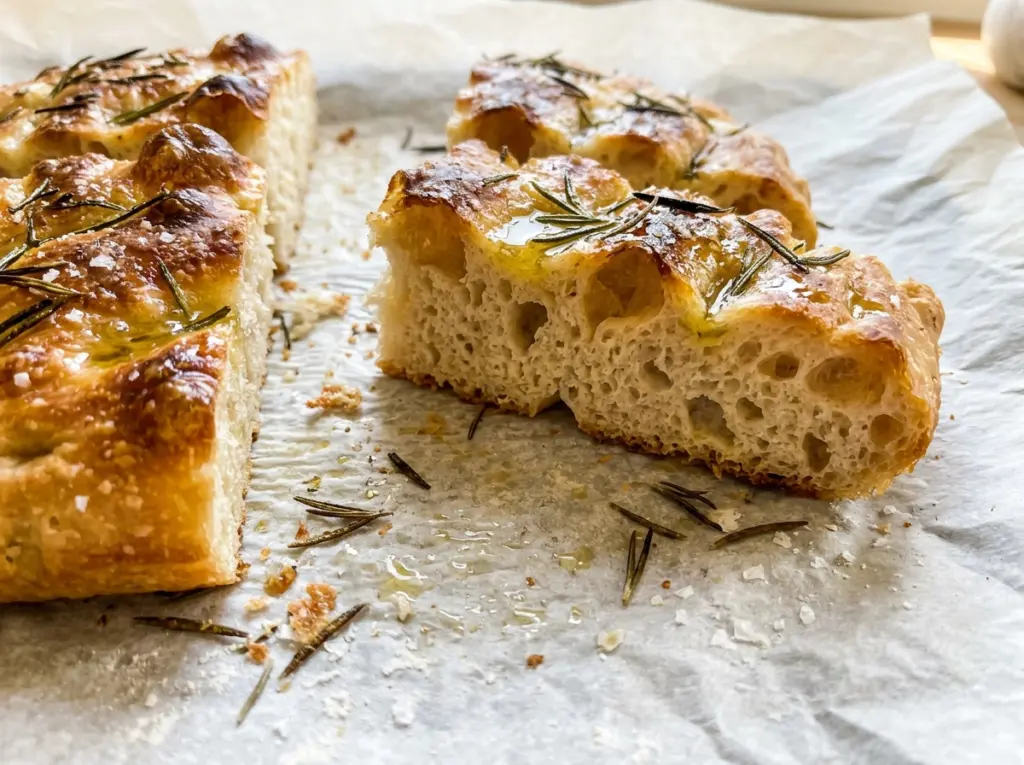
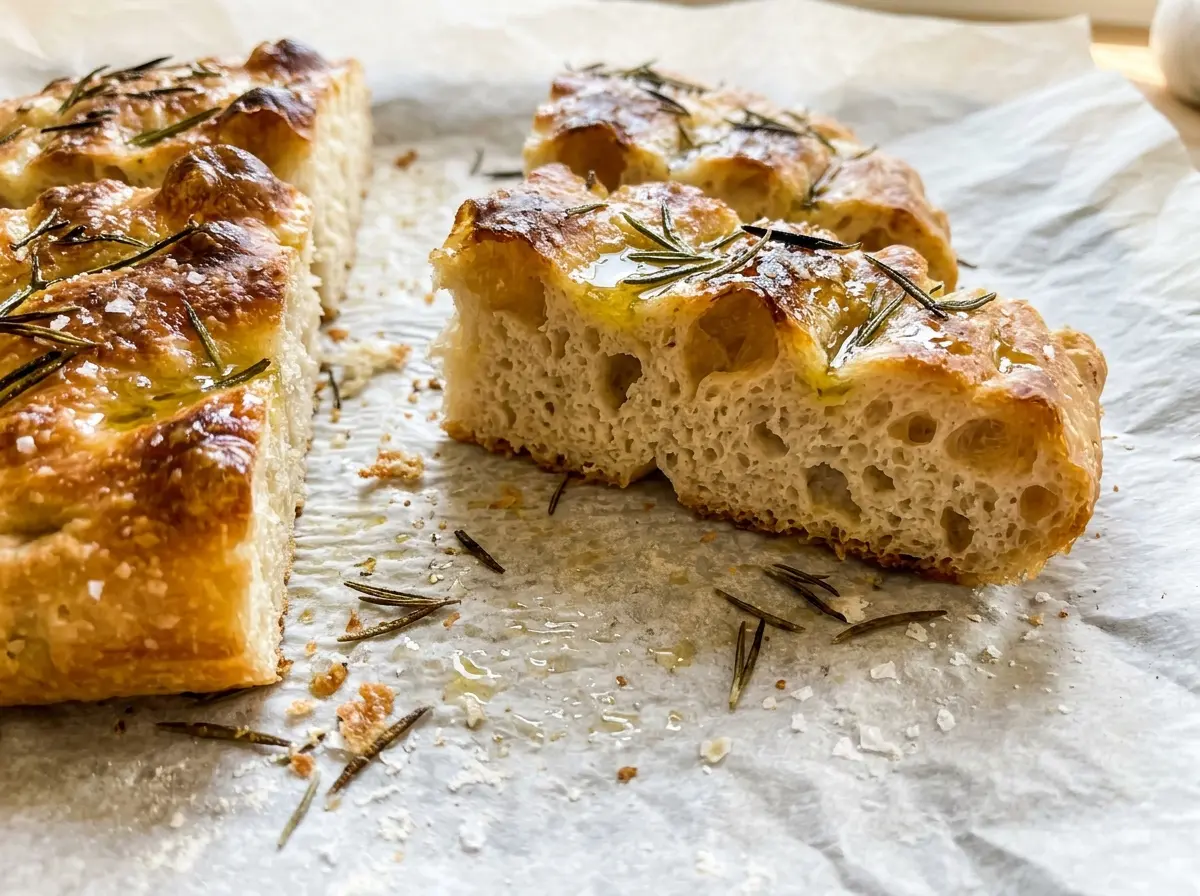
The olive oil around the edges of the pan turns the bottom of this focaccia deeply golden, while the top stays tender under its rosemary and flaky salt. I like that contrast in every square: a little crunch underneath, a soft, airy middle, and dimples that catch the oil instead of letting it run straight off. Rosemary focaccia bread is worth the slow rise, but it doesn’t ask for complicated shaping or special equipment.
The dough gets stronger through a few gentle folds rather than a long session of kneading. Giving it time between folds lets it relax, too, which makes it easier to stretch into the pan without tearing or fighting back. Once it’s puffy, a drizzle of olive oil and a press of your fingertips are all that stand between you and a pan of golden, fragrant bread.
Kitchen Note
Flaky salt can land in little piles if you sprinkle it from too close to the dough. Hold your hand higher and scatter it across the whole surface so each cut piece gets a bit of that crisp, salty finish.
Save this rosemary focaccia for its olive-oil-rich edges, airy center, and fragrant rosemary topping.
Why Focaccia Dough Springs Back When You Stretch It
That elastic pull isn’t a sign that the dough is too dry or that you’ve done something wrong. As flour hydrates and the dough is handled, gluten develops into a stretchy network. When that network is tight, it resists being pushed out to the edges of the pan. A short rest gives it time to relax, so it can stretch farther with less force.
This is why the pauses in this dough’s rise are useful, not wasted time. The dough rests after mixing, gets folded in rounds, and has another rest once it’s in the pan. Each pause makes the next bit of handling easier. If you keep tugging while it’s pulling back, you’re more likely to tear it or press out the air that’s building inside. Letting the dough relax gives you a more even layer and a lighter crumb without needing to knead it aggressively.
Keep that in mind when you reach the edges: aim for gentle, gradual stretches rather than one hard pull. Focaccia doesn’t need to be perfectly uniform, but it does benefit from a relaxed dough that hasn’t been forced into place.
What the Flour, Olive Oil, and Rosemary Each Bring

- All-purpose flour — It gives this focaccia a tender crumb that still holds its shape when sliced. A standard store-brand bag works well; there’s no need to seek out specialty flour. Bread flour is a possible swap, but it tends to make a chewier loaf, so all-purpose flour is my pick for this texture.
- Active dry yeast — The yeast creates the rise and the airy interior. Check that it foams after standing in the warm water and sugar; a fresh, inexpensive packet is fine. Instant yeast can replace it in the same quantity; stir instant yeast into the flour rather than waiting for a foam cap.
- Olive oil — Oil in the dough keeps the crumb tender, and the oil in the pan helps the edges and bottom brown. A flavorful extra-virgin oil makes a difference in the aroma, but a basic olive oil works, too. If you’re out, a neutral oil can fill in at the same quantity, though you’ll lose olive oil’s fruity, peppery character.
- Fresh rosemary — Fresh leaves bring a piney fragrance that holds up against the oil and salt. Choose sprigs that smell lively, not faded or dry. Dried rosemary works in a pinch; use about one teaspoon in place of one tablespoon fresh, and rub it between your fingers before sprinkling to release its aroma.
- Flaky sea salt — The broad crystals give the surface a crisp, clean hit of salt. This is where texture matters most, so use flaky salt if you have it; fine salt dissolves quickly and won’t give the same little crunch.
From the First Fold to the Deep-Golden Crust
Wake up the yeast and hydrate the flour
Stir the warm water, active dry yeast, and sugar together in a large bowl, then leave the mixture for 5 to 10 minutes until it’s foamy. Add the flour, fine salt, and part of the olive oil, stirring until no dry flour remains. The dough will look rough and sticky at this point; that’s expected. Cover it and let it rest for 20 minutes before folding.
Build strength with gentle folds
Wet your hands, lift one edge of the dough, and fold it over the center. Rotate the bowl and repeat until you’ve folded all four sides. Cover the bowl and repeat the folding round every 20 minutes for two more rounds, then let the dough rise for 30 to 60 minutes, until doubled. Avoid adding extra flour to make the dough easier to handle; wet hands are enough to keep it from clinging.
Stretch the dough without forcing it
Grease a 9×13-inch baking pan with olive oil, transfer the dough into it, and turn the dough once to coat it. Cover and let it rest for 15 minutes, then gently stretch it toward the edges. If it springs back, give it 10 minutes to relax before stretching again. Cover the pan and let the dough rise for 45 to 60 minutes, until it looks puffy.
Dimple, season, and bake until deeply golden
Heat the oven to 425°F. Drizzle the remaining olive oil over the dough and press all over with oiled fingertips to make dimples, then sprinkle on the rosemary and flaky sea salt. Bake for 22 to 28 minutes, watching for a deeply golden surface rather than pulling it while it’s still pale. Let the focaccia cool in the pan for 10 minutes before cutting; that brief pause makes it easier to slice cleanly.
Three Small Ways to Change the Rosemary Focaccia
A gentler rosemary bite
Chop the fresh rosemary more finely before topping the dough. The same amount spreads across more of the surface, so you get a little herbal flavor in more bites rather than larger, distinct pieces.
A more olive-forward crust
Use a robust extra-virgin olive oil for the dough and pan. It brings a more pronounced fruity, peppery aroma to the finished bread; a mild olive oil gives you a subtler result without changing the method.
A rosemary-free version
Leave off the rosemary and keep the flaky sea salt. You’ll have a simpler, salt-forward focaccia that lets the olive oil stand out; the dough and baking method stay the same.
Storage and Reheating
- Room temperature: Keep the focaccia in an airtight container for up to 2 days. The crust softens as it sits, but the crumb stays tender.
- Freezer: Freeze cut pieces in a sealed freezer bag for up to 2 months. Let pieces thaw at room temperature before reheating.
- Reheating: Warm pieces in a 350°F oven until heated through and the edges crisp again. The microwave is faster, but it softens the crust.
Questions That Come Up While Making Focaccia
Rosemary Focaccia Bread
Ingredients
Equipment
Method
- In a large bowl, stir together the warm water (105°F to 110°F), active dry yeast, and granulated sugar.
- Let the mixture stand for 5 to 10 minutes, until foamy.
- Add the all-purpose flour, fine salt, and 2 tablespoons of the olive oil; stir until no dry flour remains.
- Cover and let the dough rest for 20 minutes.
- With wet hands, stretch one edge of the dough up and fold it over the center; rotate the bowl and repeat 3 more times.
- Cover and repeat this folding process every 20 minutes for 2 more rounds.
- Let the dough rise for 30 to 60 minutes, until doubled.
- Grease a 9x13-inch baking pan with 2 tablespoons of the olive oil.
- Transfer the dough to the pan and turn it over to coat it in oil.
- Cover and let the dough rest for 15 minutes.
- Gently stretch the dough toward the edges of the pan; if it springs back, let it rest for 10 minutes and stretch again.
- Cover and let the dough rise for 45 to 60 minutes, until puffy.
- Heat the oven to 425°F.
- Drizzle the remaining 2 tablespoons of olive oil over the dough and dimple it all over with oiled fingertips.
- Sprinkle the chopped fresh rosemary and flaky sea salt over the dough.
- Bake for 22 to 28 minutes, until deeply golden brown.
- Let the focaccia cool in the pan for 10 minutes before cutting and serving.