

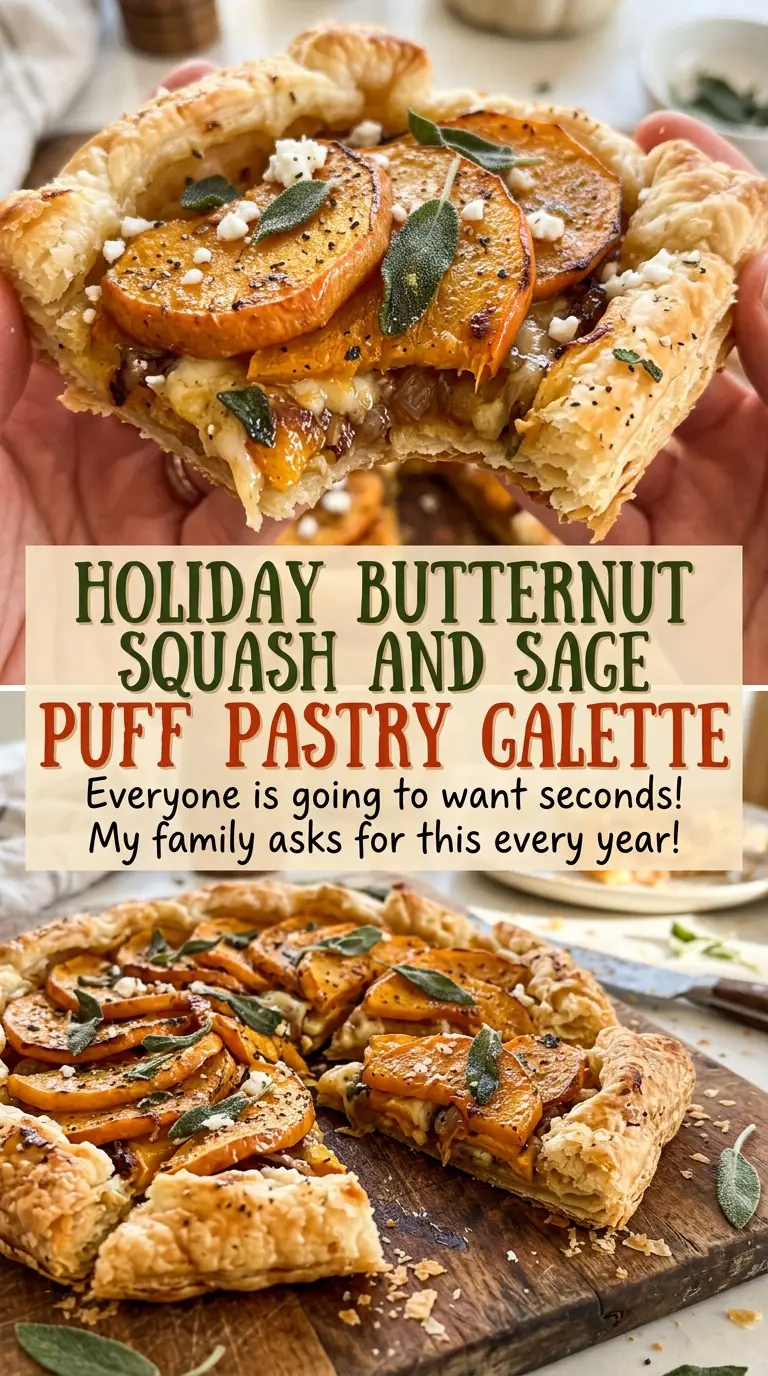
The squash comes out of the oven with browned edges and soft centers, while the puff pastry needs a hotter, drier filling to rise into crisp layers. That balance is what makes this Holiday Butternut Squash and Sage Puff Pastry Galette work: you get tender squash and tangy goat cheese tucked inside a flaky, golden crust, without asking the pastry to bake around raw vegetables.
I like the way the sage goes in after the squash roasts. Its fresh, woodsy aroma stays clear instead of getting lost in the oven, and the goat cheese gives the filling a creamy contrast to the sweet squash. Each slice has a little of everything, with a pleated edge that looks lovely without requiring a fussy pastry technique.

Kitchen Note
Puff pastry is easiest to roll and fold while it’s thawed but still cold. If it starts feeling soft or sticky under your hands, pause and chill it briefly rather than stretching it into shape.
Save this Holiday Butternut Squash and Sage Puff Pastry Galette for a savory centerpiece with browned squash, tangy goat cheese, and crisp, golden pastry.
Why the Squash Roasts Before the Pastry Goes Anywhere Near the Oven
Butternut squash holds plenty of moisture, and raw cubes need time in the oven before they turn tender. Putting them straight onto puff pastry would ask the pastry to bake while the squash releases steam. That steam works against the crisp, flaky layers you want in a galette.
Roasting the squash separately solves two problems at once. The high heat gives the cubes a chance to brown, which deepens their sweetness, and it lets excess moisture evaporate before the filling meets the pastry. Cooling the squash before assembly matters for the same reason: a hot filling sends steam into the dough before it can puff. The result is a more distinct contrast between the soft center and the crisp shell, rather than a damp layer under the filling.
The pastry also gets its own oven temperature after the squash comes out. That change lets the squash roast until browned without forcing the pastry through the same hotter bake. Once the filling is ready, the pastry can puff and turn deep golden around it.
What the Squash, Sage, and Goat Cheese Each Bring to This Galette
- Butternut squash — Fresh squash cut into even cubes roasts at a similar rate and browns more reliably than pieces of mixed sizes. Choose a firm squash with no soft spots; peeling and seeding it before cutting gives you clean, bite-size pieces. Sweet potato is a practical variation, but it brings a denser, earthier sweetness.
- Fresh sage — Chopped fresh leaves give the filling a bright, savory fragrance that balances the squash. Use leaves that look fresh and smell aromatic; the dried version is more concentrated and won’t give quite the same fresh lift. Stir the sage into the squash after roasting, rather than roasting the leaves with the cubes.
- Puff pastry — The pastry sheet supplies the crisp, layered structure around the filling, so its condition matters more than brand. Thaw it enough to unfold and roll, but keep it cold while you work. A gluten-free sheet can be used for a gluten-free adaptation if it rolls to a similar size.
- Goat cheese — Its creamy tang cuts through the squash’s sweetness and gives the filling a soft, savory layer. Crumbled cheese is easy to distribute across the pastry without making a thick, uneven mound. A dairy-free soft cheese is an option for a dairy-free version, though the flavor will be milder and the texture may soften more as it bakes.
- Egg — Beaten with water, the egg makes a simple wash for the pastry border. Brush it over the folded dough for a deep golden finish; keep the wash on the pastry rather than letting it pool on the baking sheet.
Roast First, Then Build a Crust That Stays Crisp
Roast the cubes until browned at the edges
Heat the oven to 425°F and spread the squash across an 18×13-inch rimmed baking sheet. Toss it with the olive oil, kosher salt, and black pepper, then roast for 20–25 minutes, stirring once halfway through. Look for tender cubes with browned patches, not pale, steamed-looking sides. Transfer them to a bowl when they’re ready.
Let the sage meet the squash off the heat
Stir the chopped fresh sage into the hot squash, then let the mixture cool for 10 minutes. The cubes should still hold their shape rather than collapse when stirred. Don’t rush the cooling stage by piling hot squash onto the pastry; it needs to be cool before assembly so the pastry can bake without a hot, steamy filling weighing it down.
Give the pastry a border before adding the filling
Reduce the oven to 400°F and line a second 18×13-inch rimmed baking sheet with parchment paper. Roll the thawed puff pastry on the parchment into a roughly 10×13-inch rectangle, then spread the crumbled goat cheese over it while leaving a 1-inch border. Add the cooled squash over the cheese, distributing it so no part of the center is overloaded. If the border gets covered, it’ll be harder to fold neatly over the filling.
Pleat the edge and bake until deep gold
Fold the pastry border over the filling, making small pleats as you work around the rectangle. Beat the large egg with the water and brush the mixture over the pastry edges. Bake for 25–30 minutes, until the pastry is puffed and deep golden brown; a pale crust needs more time to develop crisp layers. Let the galette rest for 10 minutes before slicing.
Three Practical Ways to Change the Filling or Pastry
Swap in sweet potato
Use sweet potato cubes cut to the same size in place of the butternut squash, keeping the rest of the filling and roasting method unchanged. The filling will taste earthier and a little sweeter, with a denser texture than the squash version.
Use gluten-free puff pastry
Choose a gluten-free puff pastry sheet and roll it on the parchment to a similar rectangle. Some gluten-free pastry is more delicate, so press the folds gently instead of stretching the dough; the finished crust may be less airy, but it still gives the galette a crisp shell.
Make it dairy-free
Use dairy-free puff pastry and replace the goat cheese with a plain dairy-free soft cheese. The filling will lose some of the goat cheese’s tang, and the center may be softer, but the squash and sage still make a savory pairing.
Storage and Reheating
- Refrigerator: Store leftover galette covered for 3–4 days. The pastry will soften as it sits.
- Freezer: I don’t recommend freezing the baked galette; the squash softens and the pastry loses its crisp, flaky texture.
- Reheating: Warm slices in the oven until heated through and crisp again. Skip the microwave if you want to revive the pastry rather than make it softer.
Questions That Come Up While Making This Squash Galette
Holiday Butternut Squash and Sage Puff Pastry Galette
Ingredients
Equipment
Method
- Heat the oven to 425°F.
- Spread the squash on an 18x13-inch rimmed baking sheet and toss it with the olive oil, salt, and pepper.
- Roast for 20–25 minutes, stirring once halfway through, until the squash is tender and browned.
- Transfer the squash to a bowl and stir in the sage.
- Let the squash cool for 10 minutes.
- Reduce the oven temperature to 400°F.
- Line a second 18x13-inch rimmed baking sheet with parchment paper.
- Roll the puff pastry on the parchment into a roughly 10x13-inch rectangle.
- Spread the goat cheese over the pastry, leaving a 1-inch border.
- Top the pastry with the cooled squash.
- Fold and pleat the border over the filling.
- Beat the egg with the water and brush it over the pastry edges.
- Bake for 25–30 minutes, until the pastry is puffed and deep golden brown.
- Rest the galette for 10 minutes before slicing.