
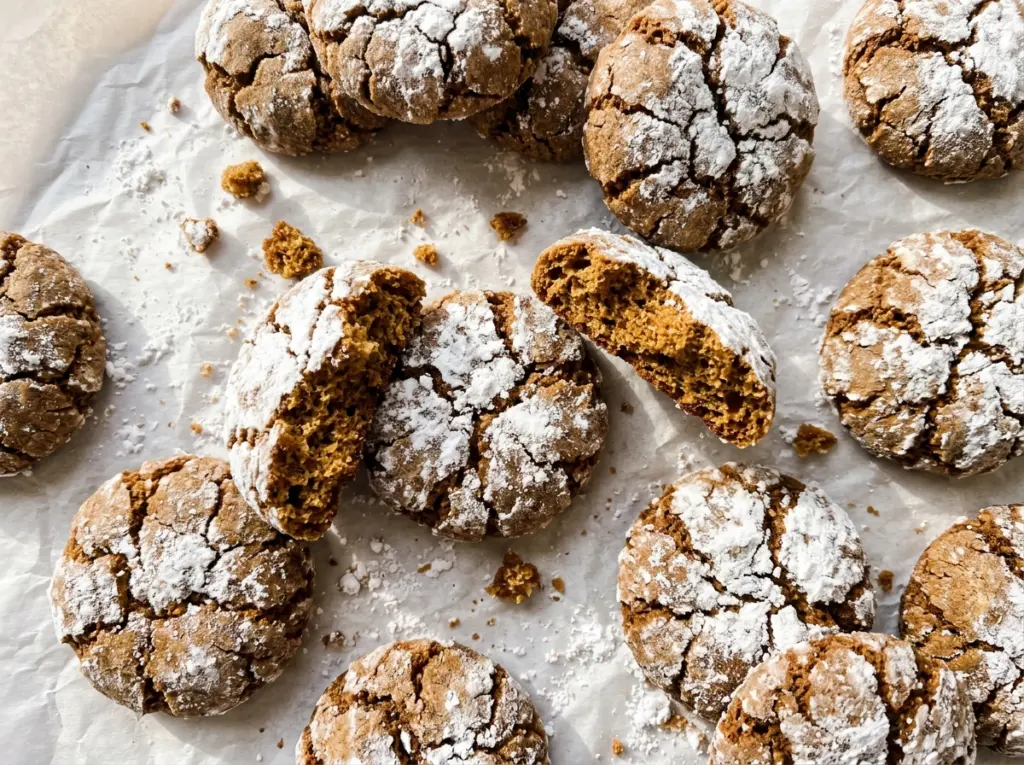
The first tray comes out of the oven with powdered sugar split into bright white islands over the dark, spiced dough. The edges look set, but the centers still feel soft. That contrast is exactly what I want from gingerbread crinkle cookies: a lightly crisp outside and a tender middle that tastes of ginger and molasses.
Unsulphured molasses gives these cookies their deep gingerbread flavor without making the spice blend feel harsh. Ground ginger leads, while cinnamon, cloves, and nutmeg round it out. I chill the dough before shaping so it’s easier to portion and roll, then coat each ball generously in powdered sugar. As the cookies puff in the oven, the coating breaks into those familiar crinkles, leaving a little of the dark dough visible between the white cracks.
Kitchen Note
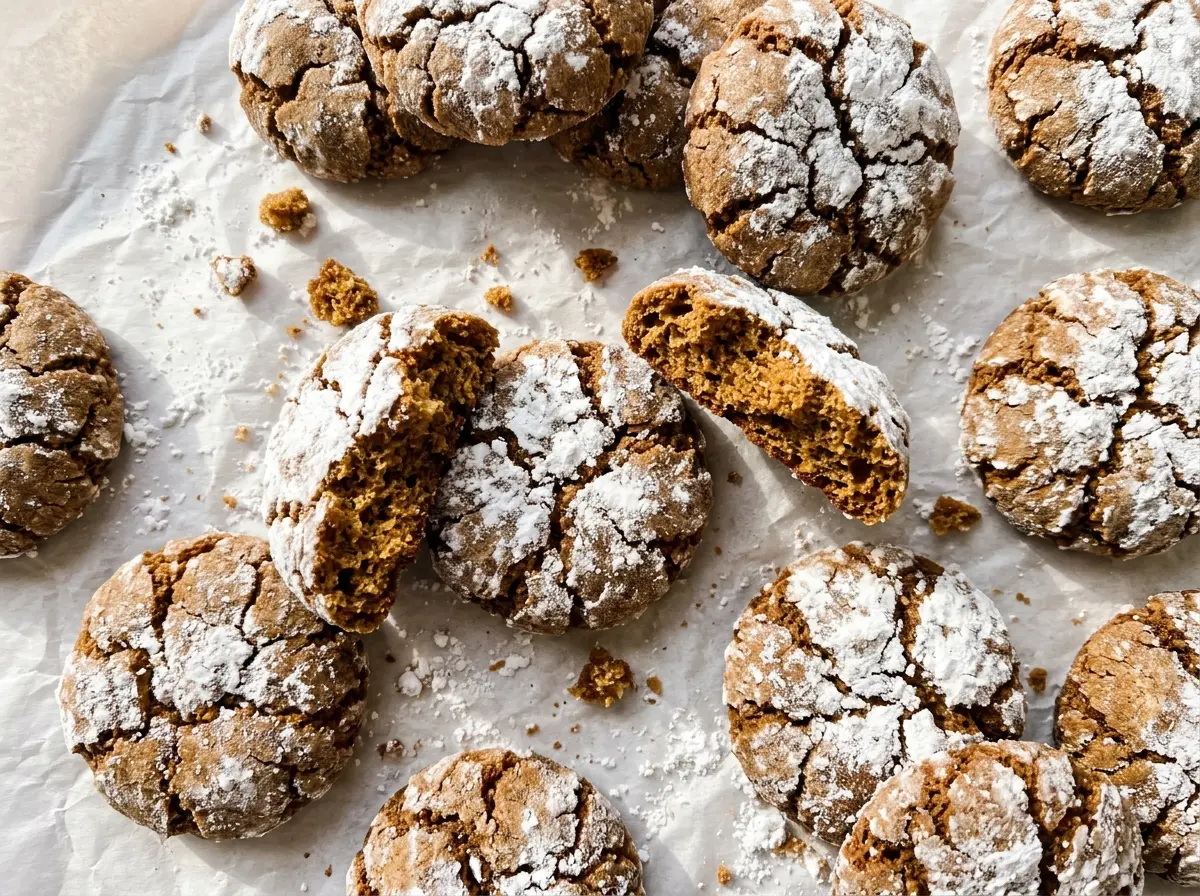
Give the cookies the full five minutes on the baking sheet before moving them. They’re delicate right out of the oven, and that short rest lets them firm up enough to lift without breaking.
Save these gingerbread crinkle cookies for a bake with warm ginger, soft centers, and snowy crackled tops.
Why the Powdered-Sugar Crust Cracks Instead of Disappearing
Crinkle cookies need a coating that can split as the dough expands. Here, the chilled dough starts as a compact ball, then puffs in the oven. The powdered sugar stays on the surface while the cookie opens beneath it, creating pale patches against the dark gingerbread. A light dusting won’t give you the same contrast; the coating needs to be generous enough to remain visible as the dough spreads and cracks.
The dough’s color matters, too. Molasses and brown sugar make a deep, warm base, so each crack shows clearly. The baking soda helps the cookies puff, while the balance of flour and butter keeps them from turning into thin, crisp rounds. If the dough is soft and hard to handle before it’s shaped, give it the full chill rather than adding extra flour. More flour can make the finished cookies dry and dull the spice.
Think of the powdered sugar as a proper coating, not a finishing sprinkle. Roll the whole dough ball through it until no bare patches remain. Once the cookies bake, that white layer breaks into the craggy pattern that makes these look like gingerbread crinkles instead of ordinary spice cookies.
What Molasses and the Spice Blend Contribute to These Crinkles

- All-purpose flour — It gives the cookies enough structure to puff and hold their shape. Spoon it into the measuring cup and level the top instead of packing it in; too much flour can leave the centers dry. For a gluten-free version, use a measure-for-measure baking flour blend that includes xanthan gum.
- Ground ginger and the other spices — Ginger brings the distinct warm bite, and cinnamon, cloves, and nutmeg make it rounder. Use spices that still smell fragrant when you open the jar; old, faded spices make a muted cookie. If you’re out of cloves, replace them with the same amount of ground allspice for a slightly different, warmer spice note.
- Unsalted butter and light brown sugar — Softened butter creams smoothly with the sugar, and the packed brown sugar adds moisture and a mellow caramel note. Dark brown sugar works in the same amount if you want a deeper flavor. If salted butter is what you have, reduce the added salt by half.
- Unsulphured molasses — This is what gives the dough its recognizable gingerbread depth and helps keep the centers tender. Choose regular unsulphured molasses rather than blackstrap, which has a much stronger, more bitter taste for these cookies.
- Powdered sugar — Its fine texture coats the dough evenly and creates the snowy finish. Granulated sugar won’t give the same crackled white surface, so stick with powdered sugar for the coating.
- Egg and vanilla — The egg helps bind the dough, while vanilla softens the edges of the spice flavor. Use a large egg at room temperature if convenient; there’s no need to buy a special extract for this recipe.
Mixing, Chilling, and Baking the Dough Without Losing the Crinkles
Whisk the dry ingredients until the spices are evenly spread
Whisk the flour, ground ginger, cinnamon, cloves, nutmeg, baking soda, and salt together in a medium bowl. Break up any spice clumps as you whisk so the finished cookies don’t get an isolated pocket of one seasoning. Set the bowl aside while you cream the butter and sugar. An even dry mixture makes it easier to combine the dough without overmixing later.
Cream the butter and sugar until light and fluffy
Beat the softened butter and packed light brown sugar in a large bowl with an electric mixer on medium speed for about 2 minutes. The mixture should look lighter and fluffy rather than dense or greasy. Beat in the egg, molasses, and vanilla, scraping down the bowl so no streaks of butter are left at the bottom. The mixture may look loose after the molasses goes in; that’s fine.
Mix gently, then chill the covered dough
Add the flour mixture and mix on low just until no dry streaks remain. Stop as soon as the last flour disappears; prolonged mixing can make the cookies tougher. Cover the bowl and refrigerate the dough for 1 hour. Chilling makes the dough easier to portion and roll into neat balls.
Coat each ball and bake one sheet at a time
Heat the oven to 350°F and line two large baking sheets with parchment paper. Put the powdered sugar in a small bowl, scoop the chilled dough into 1 1/2-tablespoon portions, roll each portion into a ball, and coat it generously. Arrange 12 balls on each sheet with about 2 inches between them, then bake one sheet at a time for 10 to 12 minutes. Look for puffed, crackled cookies with set edges and soft centers; after their short rest on the baking sheet, transfer them to a wire rack to cool completely.
Three Small Changes for a Different Gingerbread Crinkle
Make the batch gluten-free
Replace the all-purpose flour with the same amount of a measure-for-measure gluten-free baking blend that contains xanthan gum. The cookies will have a slightly more delicate crumb, so let them rest on the baking sheet before moving them.
Trade the cloves for allspice
Use the same amount of ground allspice in place of the ground cloves. You’ll keep the warm, rounded spice character but shift it away from the sharper note of cloves.
Use dark brown sugar for a deeper note
Swap in dark brown sugar in the same amount as the light brown sugar. The cookies will taste a little more robust and molasses-forward, while keeping the same gingerbread shape and powdered-sugar finish.
Storage and Reheating
- Refrigerator: Store in an airtight container for up to 1 week; cold storage can firm the cookies and soften the powdered-sugar coating, so room-temperature storage is better.
- Freezer: Freeze completely cooled cookies in an airtight container for up to 2 months. Thaw them at room temperature; the sugar coating may be less crisp afterward.
- Reheating: These are good at room temperature. To warm one, microwave it for about 5 seconds; longer heating can dry the edges.
Questions That Come Up When Making Gingerbread Crinkles
Gingerbread Crinkle Cookies
Ingredients
Equipment
Method
- Preheat the oven to 350°F.
- Line two large baking sheets with parchment paper.
- Whisk the flour, ginger, cinnamon, cloves, nutmeg, baking soda, and salt in a medium bowl.
- In a large bowl, beat the butter and brown sugar with an electric mixer on medium speed until light and fluffy, about 2 minutes.
- Beat in the egg, molasses, and vanilla until combined, scraping down the bowl as needed.
- Add the flour mixture and mix on low just until no dry streaks remain.
- Cover the dough and refrigerate for 1 hour.
- Put the powdered sugar in a small bowl.
- Scoop the chilled dough into 1 1/2-tablespoon portions.
- Roll each portion into a ball.
- Coat each ball generously in powdered sugar.
- Arrange 12 balls on each prepared baking sheet, leaving about 2 inches between them.
- Bake one sheet at a time for 10 to 12 minutes, until the cookies are puffed and crackled with set edges and soft centers.
- Cool the cookies on the baking sheet for 5 minutes.
- Transfer the cookies to a wire rack to cool completely.