

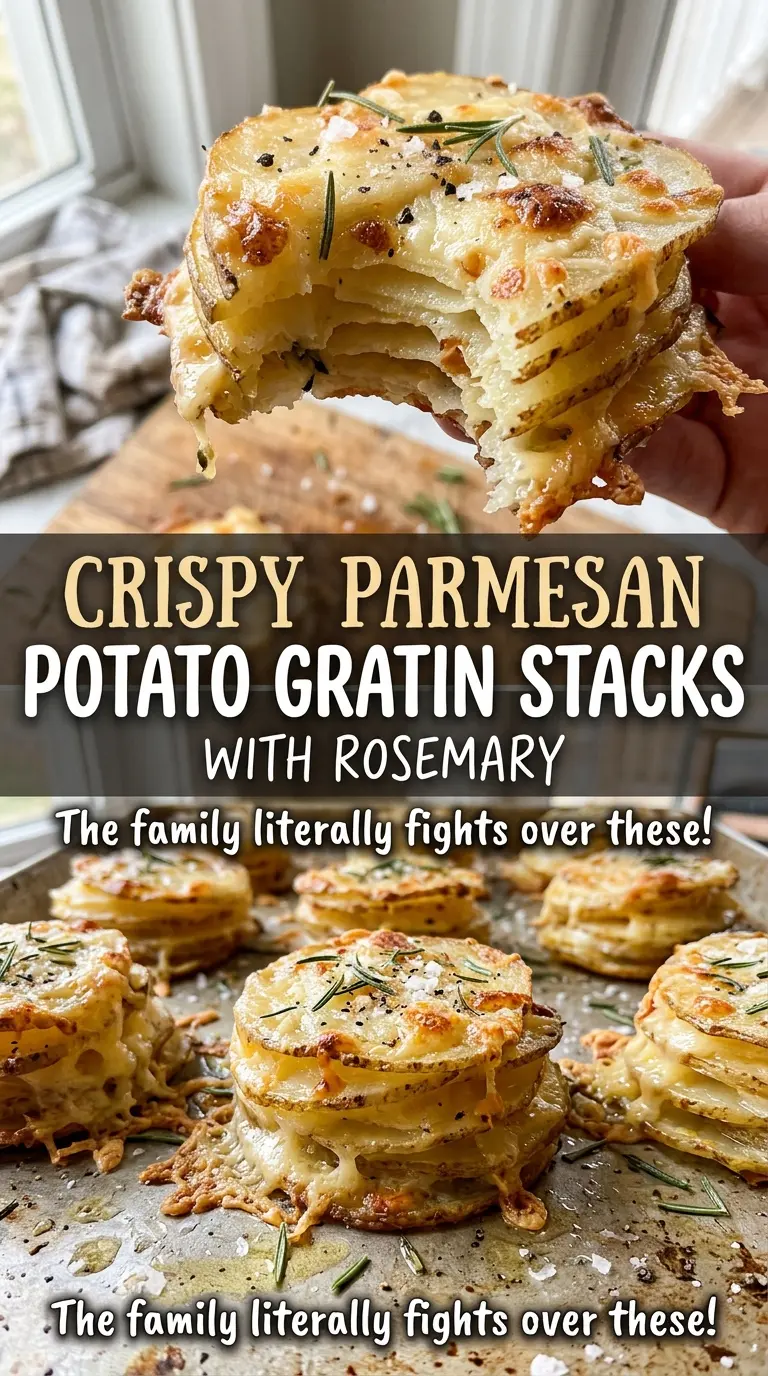
When the muffin pan comes out of the oven, the potato edges should be deeply golden while the centers stay tender enough for a knife to slip through. That contrast is what makes these crispy Parmesan potato gratin stacks with rosemary worth making: crisp, savory edges give way to soft, buttery layers, and each portion lifts out as its own little stack.
I toss the thin potato rounds with melted butter, Parmesan, garlic, rosemary, salt, and pepper before they go into the pan, so the seasoning reaches the layers instead of sitting only on top. A second sprinkle of Parmesan finishes each stack and browns as it bakes. The rosemary perfumes the potatoes without overwhelming them, and the grated garlic disappears into the butter, leaving every bite savory and balanced.

Kitchen Note
Give the stacks their full five-minute rest before you try to lift them out. The Parmesan edges firm up a little as they sit, which makes it easier to loosen each stack without tearing away its crisp sides.
Save these crispy Parmesan potato gratin stacks with rosemary for a side dish that turns thin potato layers into golden, individual portions.
Why These Potato Stacks Need to Start Above the Muffin-Pan Rims
Potato rounds settle as they soften in the oven, so a stack that looks a little too tall before baking usually isn’t too tall at all. Divide the slices among the wells and let them rise slightly above the rims. They’ll compact as they cook, leaving you with tidy portions instead of squat layers that barely fill the pan.
There’s a balance here: stack the slices neatly, but don’t press them down into a dense plug. A loose, slightly uneven pile gives the butter and Parmesan room to work between the layers, while the exposed edges can brown. If you fill each well only to the rim, the finished stacks tend to look flatter and have less crisp potato around the sides. The extra height at the start is a small detail, but it’s what gives these stacks their distinct layered shape after baking.
What Yukon Golds, Parmesan, and Rosemary Bring to Each Layer
- Yukon Gold potatoes — Their creamy texture works well in thin, layered stacks without turning as mealy as a starchier potato can. Scrub them well before slicing; there’s no need to peel them. Red potatoes are a workable swap if that’s what you have, though the centers will be a little firmer. Russets are starchier and more likely to break apart, so Yukon Golds are my first choice.
- Parmesan — Finely grated cheese coats the slices and gives the edges their salty, browned finish. Grating a block yourself gives the most even coating; a budget wedge is fine, but finely grated cheese matters more here than buying an expensive aged one. Pecorino Romano can replace it in the same quantity for a sharper, saltier result.
- Fresh rosemary — Its piney aroma stands up to the potatoes and Parmesan, and finely chopping it keeps the flavor distributed through the stack. Use leaves without woody stems and chop them small so you don’t end up with a tough bite. Fresh thyme is a gentler, one-for-one herb swap if rosemary isn’t available.
- Unsalted butter — Butter coats the rounds and helps the edges brown, while unsalted butter lets you control the seasoning. Melt it before tossing so it spreads across the slices rather than clumping. For a dairy-free adaptation, use plant-based butter and nutritional yeast in place of the butter and Parmesan; the stacks will still be savory, but the cheese-like topping won’t brown into the same crisp edges.
- Fresh garlic — Finely grated cloves blend into the melted butter, seasoning more evenly than larger chopped pieces would. A fine grater also keeps the garlic from forming pockets in the layers. Fresh garlic gives the cleanest flavor, though a small amount of granulated garlic can stand in if needed.
Building the Layers Before the Parmesan Turns Golden
Butter the Muffin Wells
Heat the oven to 400°F. Brush 1 tablespoon of melted butter over the bottoms and sides of the wells in a 12-cup muffin pan. Get into the corners and coat the sides rather than just greasing the flat bottoms; the potato edges touch the pan as the stacks bake. This coating helps the browned edges release when it’s time to lift the stacks out.
Season Every Potato Round
Slice the scrubbed potatoes into 1/8-inch-thick rounds and put them in a large bowl. Add the remaining 4 tablespoons melted butter, 1/2 cup Parmesan, chopped rosemary, finely grated garlic, kosher salt, and black pepper, then toss until the slices are coated. Separate rounds that have clung together so the butter and seasoning reach both sides. Keeping the slices close to the same thickness helps them cook at the same pace.
Stack Above the Rims and Add the Cheese
Divide the coated slices among the muffin wells, building each pile slightly above the rim. Arrange them in overlapping layers instead of pushing them down into a tight bundle. Sprinkle the remaining 1/4 cup Parmesan over the tops, aiming some toward the exposed edges as well. The cheese on top forms a savory crust while the buttered sides brown against the pan.
Bake Until the Centers Turn Tender
Bake for 45 to 55 minutes, until the stacks are deeply golden at the edges and a knife slides easily through the centers. The browned edges are a useful visual cue, but they don’t tell you whether the middle is tender, so test a stack with the knife. If the center still feels firm, it needs more time within the baking range. Pull the pan when both the color and tenderness cues are there.
Rest, Loosen, and Lift
Let the stacks rest in the pan for 5 minutes. Run a small knife or offset spatula around the edges to release any spots of Parmesan that have caught on the pan, then lift each stack out to serve. Work around the edges rather than prying up from the center, which can split the layered potatoes. The individual stacks are ready once they come free in one piece.
Two Ways to Adapt the Rosemary Parmesan Stacks
Make a dairy-free version
Use plant-based butter for the butter and nutritional yeast in place of the Parmesan. The rosemary, garlic, and potatoes still make a savory stack, but the top won’t develop the same crisp, browned cheese crust. Choose a firm plant-based butter rather than a soft spread for a closer texture.
Add a little heat
Toss a pinch of red pepper flakes with the potato rounds and seasonings for gentle warmth through the layers. The heat plays well with the Parmesan without covering the rosemary. Keep the flakes modest if you want the potatoes’ buttery flavor to stay in front.
Storage and Reheating
- Refrigerator: Store cooled leftovers in a covered container for 3 to 4 days. The potato layers soften in the refrigerator, and the crisp edges won’t stay crisp.
- Freezer: They can be frozen, though the potatoes will be softer after thawing. Cool completely, freeze in a single layer until firm, then transfer to an airtight container for up to 2 months.
- Reheating: Warm in a 350°F oven until heated through; this brings back more edge crispness than a microwave. Avoid microwaving if you want crisp sides, since it softens them.
Questions That Come Up When Making Potato Gratin Stacks
Crispy Parmesan Potato Gratin Stacks with Rosemary
Ingredients
Equipment
Method
- Heat the oven to 400°F.
- Brush 1 tablespoon of the melted butter over the bottoms and sides of the wells in a 12-cup muffin pan.
- Slice the potatoes into 1/8-inch-thick rounds.
- Place the potato rounds in a large bowl with the remaining 4 tablespoons melted butter, 1/2 cup Parmesan, rosemary, garlic, salt, and pepper, and toss to coat.
- Divide the potato slices among the muffin wells, stacking them slightly above the rims.
- Sprinkle the remaining 1/4 cup Parmesan over the stacks.
- Bake for 45 to 55 minutes, until the stacks are deeply golden at the edges and a knife slides easily through the centers.
- Let the stacks rest in the pan for 5 minutes.
- Loosen the edges with a small knife or offset spatula and lift the stacks out to serve.