
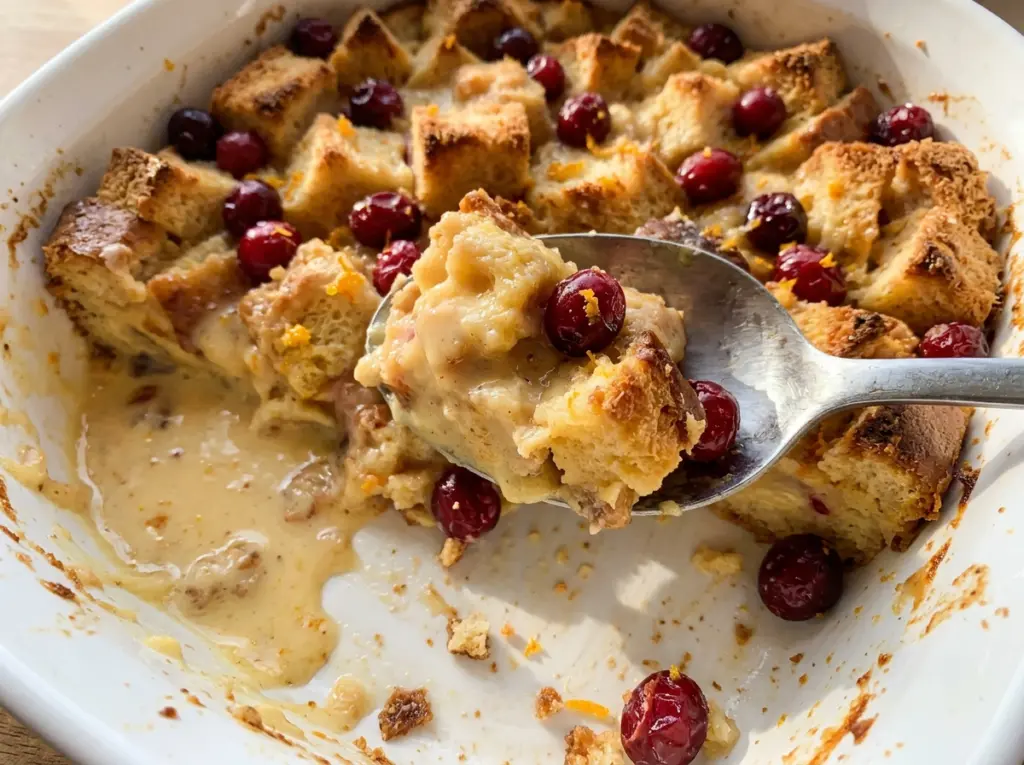
The custard turns bright with orange as soon as the zest hits the warm butter, and the cranberries bring little sharp bursts through the soft bread. That balance is what I want from cranberry orange bread pudding: rich, gently sweet, and tart enough that each bite stays interesting.
I use a French loaf and give the cubes a short turn in the oven before they meet the custard. It’s a small bit of prep that helps the bread absorb the milk and cream without collapsing into a heavy, soggy layer. Halved fresh cranberries tuck neatly between the cubes, so you get fruit throughout instead of one crowded patch. The top bakes golden while the center stays tender and spoonable.
Kitchen Note
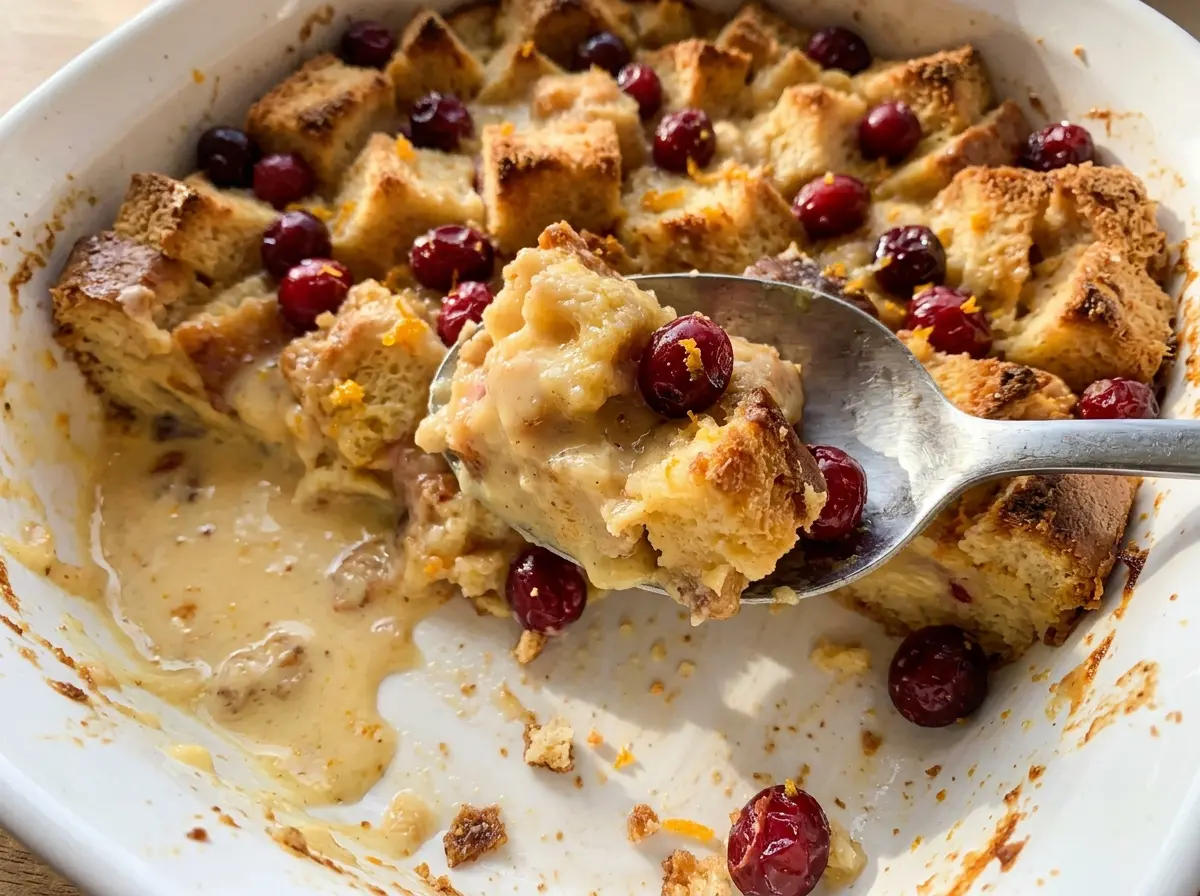
After pouring on the custard, press the cubes gently so they make contact with it, then give them the full 15-minute rest. That pause helps the bread take up the liquid evenly; pressing hard just crushes the cubes.
Save this cranberry orange bread pudding for its golden top, tender custard, and tart cranberry bites tucked through every slice.
Why Dry Bread Makes the Custard Tender, Not Heavy
Bread pudding can go from tender to dense when the bread turns soft before it has a chance to hold the custard. Fresh bread brings its own moisture to the pan, so it has less room to absorb the milk and cream. Drying the cubes first gives them a sturdier, more open texture that can take on the custard while still keeping its shape.
The oven starts low for that drying step, then the temperature rises for baking. Keep the cubes in a single layer on the rimmed baking sheet so they dry rather than steam against one another. They should feel dry on the outside when they come out; they don’t need to be toasted brown. That distinction matters: browned bread can bring a harder, more toasted edge, while dry cubes keep the finished pudding soft and custardy.
With the bread ready to absorb, the finished dish has a clear contrast: golden top, tender middle, and cranberries that hold their bright tartness. The custard should set through the center rather than leave a pool of liquid between the cubes.
French Bread, Fresh Cranberries, and the Orange That Ties Them Together

- French bread — Its sturdy crumb holds its shape after soaking, which gives the pudding a soft center instead of a uniform paste. A plain loaf works well; the oven-drying step matters more than choosing an artisan loaf. Cut the cubes evenly so they dry and bake at a similar pace.
- Fresh cranberries — Their tartness offsets the rich custard, and halving them spreads that flavor through the dish. Choose firm berries without soft spots. Frozen cranberries can stand in for fresh; use them frozen rather than thawing them first, since thawed berries release more juice before baking.
- Whole milk and heavy cream — The milk gives the custard enough liquid to soak the bread, while cream brings richness and a silky finish. Using all milk will make a lighter, less rich pudding; replacing all the milk with cream would make it heavier.
- Orange zest — Finely grated zest gives the custard fragrant citrus oils without adding extra liquid. Use a fresh orange and grate only the colored outer peel; the white pith underneath can taste bitter. Orange juice isn’t an equivalent substitute because it adds liquid without the same concentrated aroma.
- Unsalted butter — Butter greases the baking dish and adds richness when whisked into the custard. Unsalted butter keeps the seasoning predictable alongside the kosher salt. Melt it before whisking so it disperses through the eggs and dairy.
- Eggs and vanilla — Eggs are what set the custard as it bakes, and vanilla rounds out the orange and cinnamon. Use large eggs for the intended custard balance, and whisk until the mixture looks even rather than streaky.
Building the Custard and Baking Until the Center Sets
Dry the Bread Cubes Without Toasting Them
Heat the oven to 300°F and spread the 1-inch bread cubes across a rimmed baking sheet. Bake for 10–15 minutes, until the cubes feel dry, then transfer them to a bowl. Check a few from the middle of the sheet, not only the ones at the edges. If the cubes are browning heavily, they’ve gone beyond the dry texture this pudding needs.
Butter the Dish and Layer the Fruit
Increase the oven temperature to 350°F and grease a 9×13-inch baking dish with 1 tablespoon of butter. Arrange the bread cubes and halved cranberries in the dish, spreading the fruit through the bread rather than leaving it all in one area. The even layer helps the custard reach the bread consistently. Keep the dish ready while you make the custard.
Whisk a Smooth, Even Custard
Melt the remaining 4 tablespoons of butter. In a large bowl, whisk it with the eggs, sugar, milk, cream, orange zest, vanilla, cinnamon, and salt until the mixture looks uniform. Scrape the zest from the sides of the bowl if it gathers there. A well-mixed custard gives each part of the dish the same balance of dairy, sweetness, and orange.
Pour, Press, and Let the Bread Soak
Pour the custard evenly over the bread and cranberries, moving around the dish so no section gets all the liquid at once. Press the bread gently into the custard, then let the dish stand for 15 minutes. Don’t mash the cubes; they should stay recognizable as pieces of bread. The surface may still show some bread after the pause, but the cubes should look moistened rather than dry.
Bake for a Golden Top and Set Center
Bake for 45–55 minutes, until the top is golden and the center is set. Check the center with an instant-read thermometer; it should register 160°F. If the top is already golden but the center hasn’t reached that point, continue baking and check again rather than judging by color alone. Let the pudding rest for 10 minutes before serving so the custard can settle into a sliceable, tender texture.
Simple Swaps for a Different Loaf or a Softer Tart-Sweet Balance
Make It Gluten-Free with a Gluten-Free Loaf
Replace the French bread with a 16-ounce gluten-free loaf and cut it into the same 1-inch cubes. Dry the cubes on the baking sheet as usual before layering them with the cranberries. Gluten-free breads vary in density, so check that the center is set rather than relying on color alone; the texture may be a little more delicate.
Use Dried Cranberries for a Chewier, Sweeter Bite
Swap the fresh cranberries for dried cranberries if you prefer a softer, sweeter fruit flavor without the tart bursts. They won’t add the same bright contrast, and their texture will stay chewy instead of turning tender and juicy. Scatter them through the bread just as you would the fresh berries.
Dial Back the Sweetness
For a less-sweet custard, reduce the granulated sugar to 1/2 cup. The cranberries will stand out more, and the orange will taste less like a dessert-style citrus note. The pudding will still set from the eggs; don’t reduce the eggs or dairy along with the sugar.
Storage and Reheating
- Refrigerator: Cover leftovers and refrigerate for 3–4 days. The custard firms as it chills, so slices will be denser than when freshly baked.
- Freezer: Freeze cooled portions tightly wrapped for up to 2 months. Thaw them in the refrigerator before reheating; the custard may be a touch softer after freezing.
- Reheating: Warm portions covered in a 325°F oven until the center reaches 165°F. Keeping them covered helps prevent the top from drying out before the middle is warm.
Questions That Come Up Before the First Slice
Cranberry Orange Bread Pudding
Ingredients
Equipment
Method
- Heat the oven to 300°F and spread the bread cubes on a rimmed baking sheet; bake for 10–15 minutes, until dry, then transfer to a bowl.
- Increase the oven temperature to 350°F and grease a 9x13-inch baking dish with 1 tablespoon of the butter.
- Arrange the bread cubes and cranberries in the prepared dish.
- Melt the remaining 4 tablespoons butter, then whisk it in a large bowl with the eggs, sugar, milk, cream, orange zest, vanilla, cinnamon, and salt.
- Pour the custard evenly over the bread and press the bread gently into it; let stand for 15 minutes.
- Bake for 45–55 minutes, until the top is golden, the center is set, and an instant-read thermometer inserted in the center registers 160°F.
- Let rest for 10 minutes before serving.