
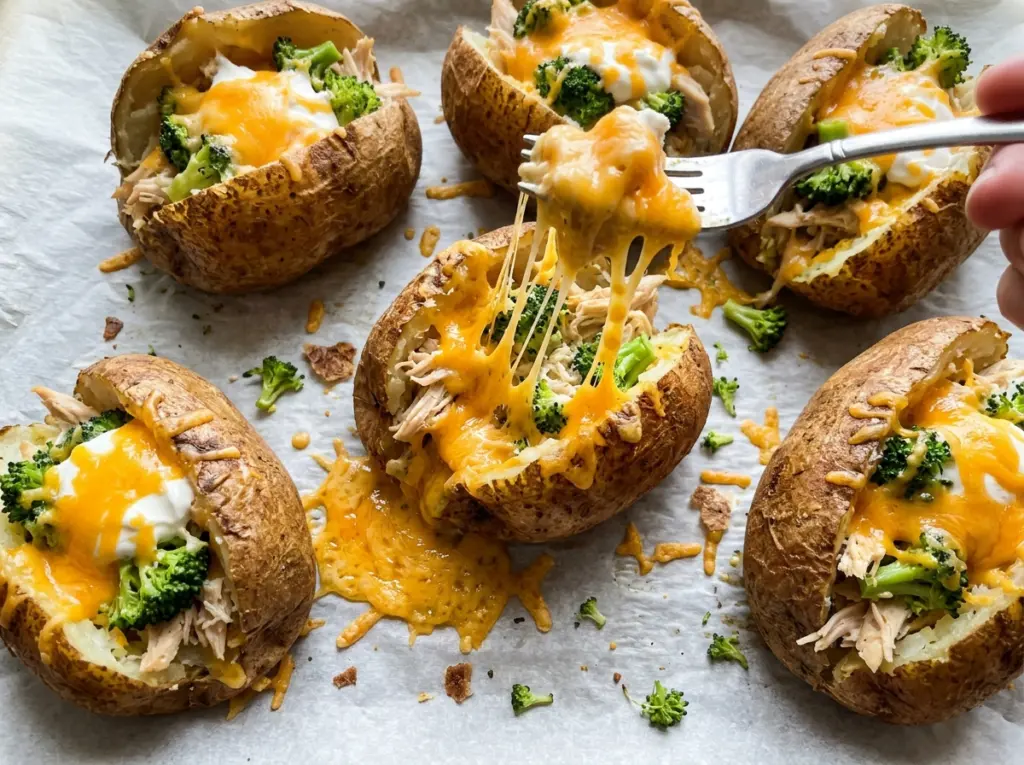
The knife should slide into a baked russet without a fight, but the skin still needs to hold its shape when you scoop out the middle. That balance is what turns an ordinary baked potato into a sturdy little bowl instead of a pile of potato on the baking sheet. These chicken and broccoli stuffed baked potatoes bring together a fluffy, buttery center with tender broccoli, shredded chicken, and a blanket of sharp cheddar.
I like this version because it feels like a complete dinner without asking the potato to do all the work. Each skin gets filled generously, and the filling stays creamy rather than dry. A little sour cream gives the mashed potato a tang that cuts through the cheese, while the broccoli keeps every bite from feeling too heavy. The tops come out melted and golden at the edges, with the filling tucked neatly inside.
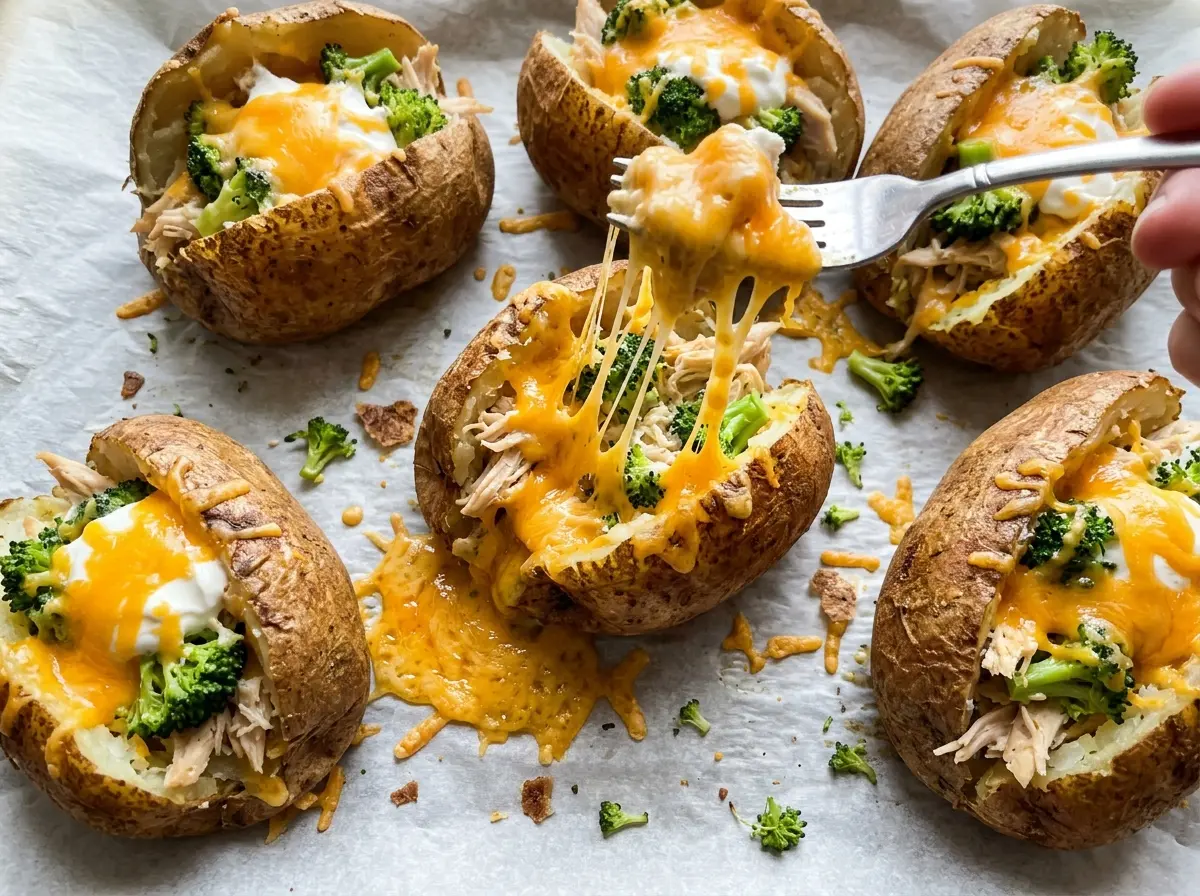
Kitchen Note
Drain the broccoli well after steaming. Any water clinging to the florets can loosen the filling, so give the colander a good shake before they go into the bowl.
Save these chicken and broccoli stuffed baked potatoes for a cozy dinner with creamy centers and melted cheddar on top.
Why the Chicken Goes In Warm Before the Potatoes Go Back in the Oven
The final bake is short: just long enough to melt the cheddar and bring the filling up to temperature. Starting with warm shredded chicken helps the center heat along with the potato instead of leaving a cold pocket under a beautifully melted top. It also keeps the filling from cooling the hot potato flesh while you mix everything together.
That matters because these are stuffed twice-baked potatoes, not a casserole with time to bubble away in the oven. The first bake softens the russets; the second bake finishes the assembled filling. Have the chicken warmed before you fold it in, and mound the filling into the shells while the potato mixture is still warm. The cheese on top should be melted by the time the center reaches 165°F. If the cheese looks ready but the center isn’t there yet, the center temperature—not the color of the top—is the cue to trust.
What Each Ingredient Brings to the Potato Filling

- Russet potatoes — Their dry, fluffy interiors mash easily, and the skins are sturdy enough to hold a generous scoop of filling. Choose large russets of similar size so they finish baking at roughly the same time; scrubbing and drying them gives the olive oil a chance to coat the skin evenly.
- Olive oil — Rubbing it over the potato skins helps them bake with a more pleasant, less papery exterior. A basic everyday olive oil is fine here; there’s no need to bring out a delicate finishing oil.
- Sour cream — It adds moisture and a gentle tang that keeps the mashed potato from tasting flat beside the cheddar. Plain full-fat Greek yogurt is the closest swap if you don’t have sour cream; the filling will taste a little tangier and feel slightly thicker.
- Broccoli florets — Small florets fit naturally into the filling and become tender quickly in the steamer. Fresh broccoli gives the most dependable texture; large pieces are harder to distribute evenly through the mashed potato.
- Cooked shredded chicken — Shredded meat spreads through the filling more evenly than large chunks, so each potato gets some in every scoop. Breast or thigh meat both work; use chicken that’s already cooked and shred it before warming.
- Sharp cheddar — Its stronger flavor stands up to the potato and sour cream without needing a heavy hand. A block you shred yourself melts more smoothly than pre-shredded cheese, though pre-shredded cheddar works if that’s what you have.
- Butter and seasonings — Butter gives the mashed potato a richer, rounder texture, while garlic powder and black pepper season the whole filling. Unsalted butter lets the kosher salt remain the main control on seasoning.
How to Keep the Shells Sturdy and the Center Creamy
Bake the russets until a knife slips in easily
Heat the oven to 400°F and prick each scrubbed, dried potato several times with a fork. Rub the skins with olive oil and part of the kosher salt, then set the potatoes on a rimmed baking sheet. Bake for 55–70 minutes, until a knife slides easily into the center; a firm spot means the filling will have an unpleasant bite later. Similar-sized potatoes help them finish together, but use the knife test rather than relying on the clock alone.
Steam the broccoli until just tender
Bring an inch of water to a boil in a medium saucepan fitted with a steamer basket. Add the small florets, cover, and steam for 4–5 minutes, until they’re bright green and just tender. Broccoli that’s cooked until very soft can disappear into the mash instead of keeping its shape. Drain it after steaming so the filling stays thick enough to mound.
Scoop and mash while the potatoes are hot
Halve each hot potato lengthwise and scoop the flesh into a large bowl, leaving about 1/4 inch inside each skin. That thin layer helps the shells stay intact when you fill them. Add the butter, sour cream, remaining salt, garlic powder, and black pepper, then mash until combined. Stop once the mixture comes together; it should look creamy, not whipped.
Fill, top, and bake until the center is hot
Fold the broccoli, warmed chicken, and part of the cheddar into the potato mixture, then divide it among the skins, mounding it as needed. Sprinkle the remaining cheddar over the tops and return the potatoes to the 400°F oven for 10–15 minutes. Look for melted cheese and a hot center; the filling should reach 165°F. Let the potatoes rest for 5 minutes before serving so the filling settles and the shells are easier to handle.
Two Simple Ways to Change the Filling
Make it a vegetarian broccoli-cheddar potato
Leave out the chicken and use cheddar labeled vegetarian if you avoid animal rennet. The potato, broccoli, sour cream, and cheese still make a satisfying filling, though it will be lighter and lower in protein than the chicken version.
Put more of the cheddar on top
Keep the same total amount of cheddar, but fold less into the filling and reserve more for the tops. You’ll get a more pronounced cheesy layer over each potato, with less cheddar running through the center.
Storage and Reheating
- Refrigerator: Cool leftovers promptly, store them covered, and use within 3–4 days. The potato may firm up as it chills.
- Freezer: These freeze reasonably well. Wrap each cooled potato individually and store airtight for up to 2–3 months; the sour-cream filling may be a little less smooth after thawing.
- Reheating: Reheat in a 400°F oven until hot throughout, or use a microwave for a quicker portion. Avoid heating until the edges are dry; the filling can lose its creamy texture.
Questions That Come Up While Making These Stuffed Potatoes
Chicken and Broccoli Stuffed Baked Potatoes
Ingredients
Equipment
Method
- Heat the oven to 400°F.
- Prick each potato several times with a fork.
- Rub the potatoes with the olive oil and 1/4 teaspoon of the salt.
- Place the potatoes on a rimmed baking sheet and bake for 55–70 minutes, until a knife slides easily into the center.
- Bring the water to a boil in a medium saucepan with a steamer basket.
- Add the broccoli, cover, and steam for 4–5 minutes, until bright green and just tender; drain.
- Halve the hot potatoes lengthwise and scoop the flesh into a large bowl, leaving about 1/4 inch of potato in each skin.
- Add the butter, sour cream, remaining 1/2 teaspoon salt, garlic powder, and pepper, and mash until combined.
- Fold in the broccoli, chicken, and 1/2 cup of the cheddar.
- Divide the filling among the potato skins, mounding it as needed.
- Sprinkle the remaining 1/4 cup cheddar over the potatoes and bake at 400°F for 10–15 minutes, until the cheese is melted and the filling reaches 165°F.
- Let the potatoes rest for 5 minutes before serving.